¶ Windows certified data
As detailed in DEAP Manual Section 3.2, the preferred source of U-value data for windows, is a certified value measured according to IS EN ISO 12567-1 or a value calculated according to IS EN ISO 10077-1 or IS EN ISO 10077-2. A BER Assessor may perform this calculation provided it strictly adheres to the applicable standard and all non-default data is provided by an accredited source. When specifying a non-default U-value in DEAP, it must be accompanied by a non-default solar transmittance value calculated according to EN 410. If the non-default solar transmittance is not available, then default U-value and solar transmittance must be used.
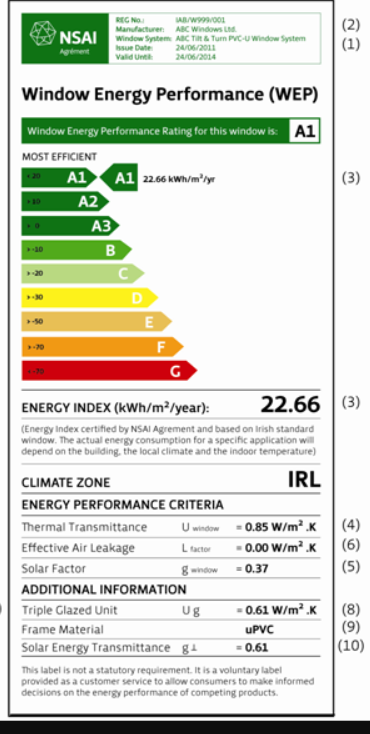
Figure 2.X shows an NSAI Window Energy Performance certificate:
- Acceptable for use in DEAP
- Make and model shown at (1) and (2). Ensure these match window(s) being assessed. If in doubt, check with the supplier/manufacturer and retain their answer in writing.
- Ensure you have proof that this window make/model is installed in the dwelling being assessed. If it is not clear if the window being assessed matches the window system/type on the certificate, seek clarification from the supplier/manufacturer and retain their answer in writing.
- U-value for DEAP shown at (4) based on relevant standards
- g┴ for DEAP shown at (10) based on relevant standards
BFRC certs are acceptable if relevant fields are shown. However, some BFRC certs don’t show the U-value and g value required. Only use documents showing the relevant performance data. Verify the BFRC certificate number against the BFRC website www.bfrc.org.
Other certified data is acceptable subject to meeting requirements in Section 3.2 of this document for both U-value and solar transmittance. BR443 Section 12 details the relevant standards for door U-value derivation.

Overview of IS EN ISO 10077-1
EN 10077-1 is a simplified method for calculating the U value of a glazed unit. It relies on knowing (amongst other things) the following:
- Thermal transmittance values of the glazing
- Transmittance factors for the gas / air mix
- Transmittance factors for the frame material
- Linear transmittance of the frame (i.e. bridging)
The standard gives several defaults for these values. If these defaults are not used then certified proof is required for the respective transmittance values that will be used, as per IS EN ISO 12567-1.

Windows frame factor
- Non-default frame factor must be for the standard window, or,
- Derive area-weighted average frame factor for all windows in the dwelling, or,
- Use defaults from Table 6c.

New glazing retrofitted to an existing frame
When an Assessor encounters retrofitted / upgraded glass in an existing window frame, they may well need to resort to the default window U-values in DEAP, bearing in mind that the U-value entered is for the entire opening (glazing + frame). Non-default values are used where there is sufficiently evidenced information to carry out a calculation to IS EN ISO 10077-1. It is unlikely that IS EN ISO 10077-2 (detailed calculation) or IS EN ISO 12567-1 (measurement) would be feasible in this case. Also, to use a non-default U-value, an Assessor would require a certified solar transmittance value as outlined above.
If intending to carry out an IS EN ISO 10077-1 calculation, the defaults must be used for any non-certified data. In any calculations being carried out, in the case where a choice needs to be made on unknown parameters, the more pessimistic option must be chosen (i.e. chose the option yielding the higher window U-value).
It is unlikely that the assessor will have access to non-default information of the existing frame into which the new glass is being installed. If intending to carry out a U-value calculation rather than resorting to defaults for the entire window, use defaults for the frame provided in IS EN ISO 10077-1 and follow the approach in IS EN ISO 10077-1 to combine certified data for the glazing (if available) with defaults for the frame. Otherwise, a default for the entire window (including frame and glazing) from the DEAP manual must be used. Calculation of overall U value according to IS EN ISO 10077-1 can be carried out in U value calculators such as that published by BRE provided adequate certified non-default is available for the glazing at least.
When specifying a non-default window U-value in DEAP, a certified non-default solar transmittance value must accompany it.