¶ Entering Non-Default Shower Data into DEAP
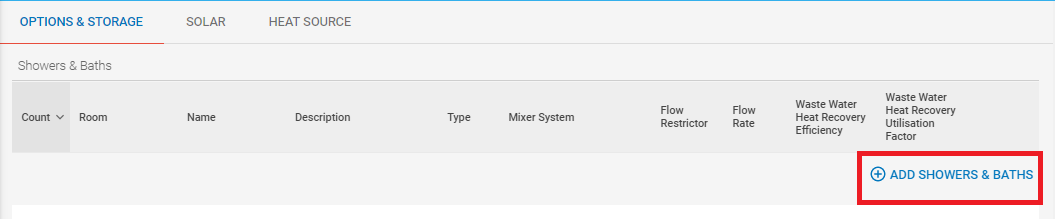
To add a shower, in Water Heating select the option to “Add Showers & Baths”:
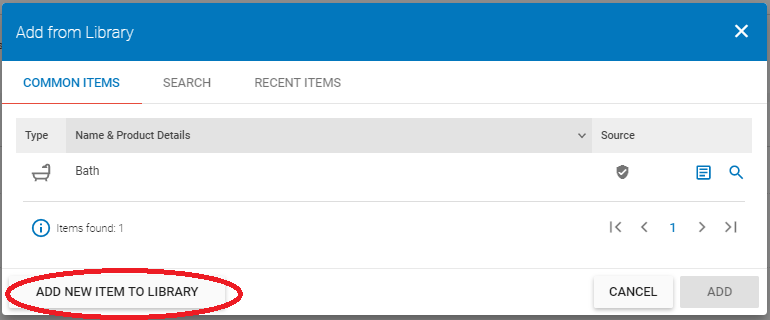
In the Search screen that pops up, to create a new shower select the option “Add New Item to Library”:
The data entry page for a shower is as follows:
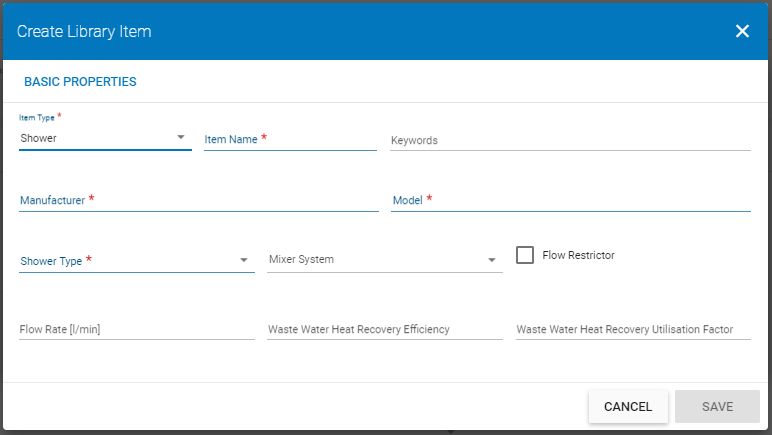
The following fields are text descriptions of the shower:
- Item Name – the name given to this shower in the DEAP Library,
- Manufacturer – the shower manufacturer,
- Model – the shower model.

Shower Type
There are 2 options in the dropdown:
- Electric – select this option for instantaneous electric showers;
- Mixer – select this option for all other shower types.
Note that for instantaneous electric showers no further information is required.

Mixer System
When you select ‘Mixer’ as the Shower Type you will need to select the Mixer System. There are 3 options to choose from based on the identification of the system as described in common shower systems:
- Vented Hot Water System,
- Vented Hot Water System + Pump,
- Unvented Hot Water System.

Flow Rate
The flow rate is the amount of water flowing through a shower, measured in litres/minute. When you choose a mixer type, DEAP will set a default Flow Rate for the shower, as follows:
Table 5.6 - Default flow rate for shower systems
| Mixer System | Default Flow Rate (l/min) |
|---|---|
| Vented Hot Water System | 7 |
| Vented Hot Water System + Pump | 12 |
| Unvented Hot Water System | 11 |
It is possible to enter a non-default flow rate for a shower as described later in this section.
Flow Restrictors
A Flow Restrictor is a device used to reduce the rate of water flow through a shower. In order to be considered in DEAP, a flow restrictor must be permanently fitted, i.e. cannot be removed without the use of tools. The European Water Label product database - see http://www.europeanwaterlabel.eu/ - has a database of flow restrictors.
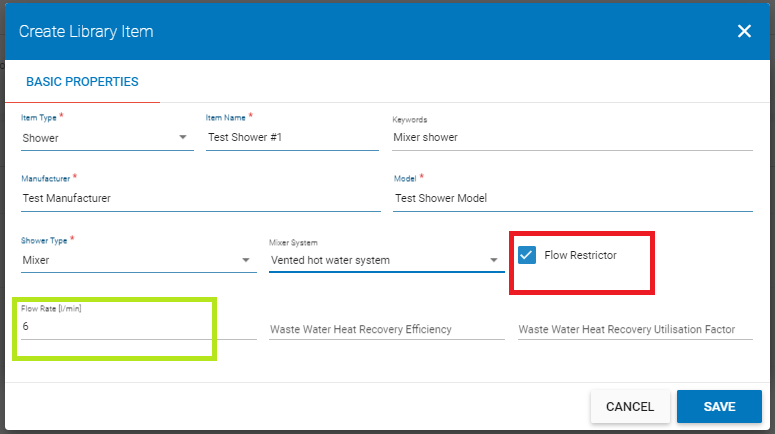
In DEAP, where a flow restrictor has been fitted permanently to a shower, the “Flow Restrictor” checkbox should be ticked. This sets the default Flow Rate to 6 litres/minute for all mixer types.
A non-default Flow Rate can be used when there is evidence to substantiate it, e.g. a technical data sheet with a CE-marking, or, where the product is listed on the European Water Label product database.
Non-default Flow Rates
Where sufficient data is available it is possible to use a non-default flow rate for a shower.
The flow rate depends on the shower unit and on the pressure of the water supplied to the unit. So, in order to use a non-default flow rate for a shower, an Assessor would typically need the following:
- Shower data sheet – showing the flow rate across a range of pressures – and with;
- A CE-marking;
- Test standard - EN 1112:2008.
- European Water Label product database - see http://www.europeanwaterlabel.eu/
- Pump datasheet – showing the water pressure the pump is capable of providing – and with,
- A CE-marking;
- Test standard - BS 5000-11:2008.
- European Water Label product database - see http://www.europeanwaterlabel.eu/
Example
In a house where the following shower and pump installed:
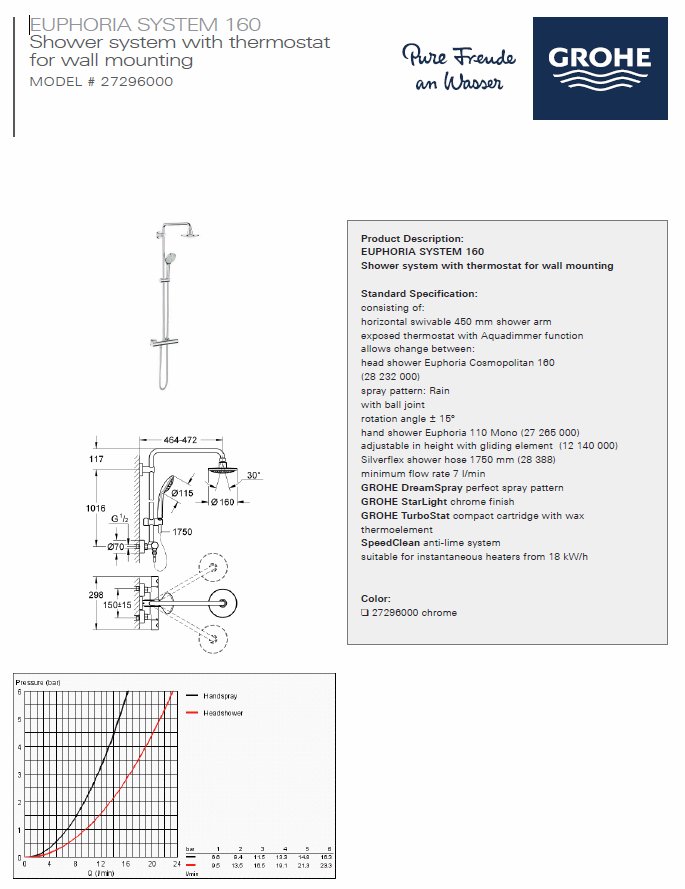
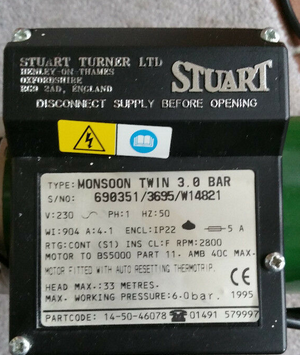
The pump brochure has the following graph of Flow vs. Pressure:
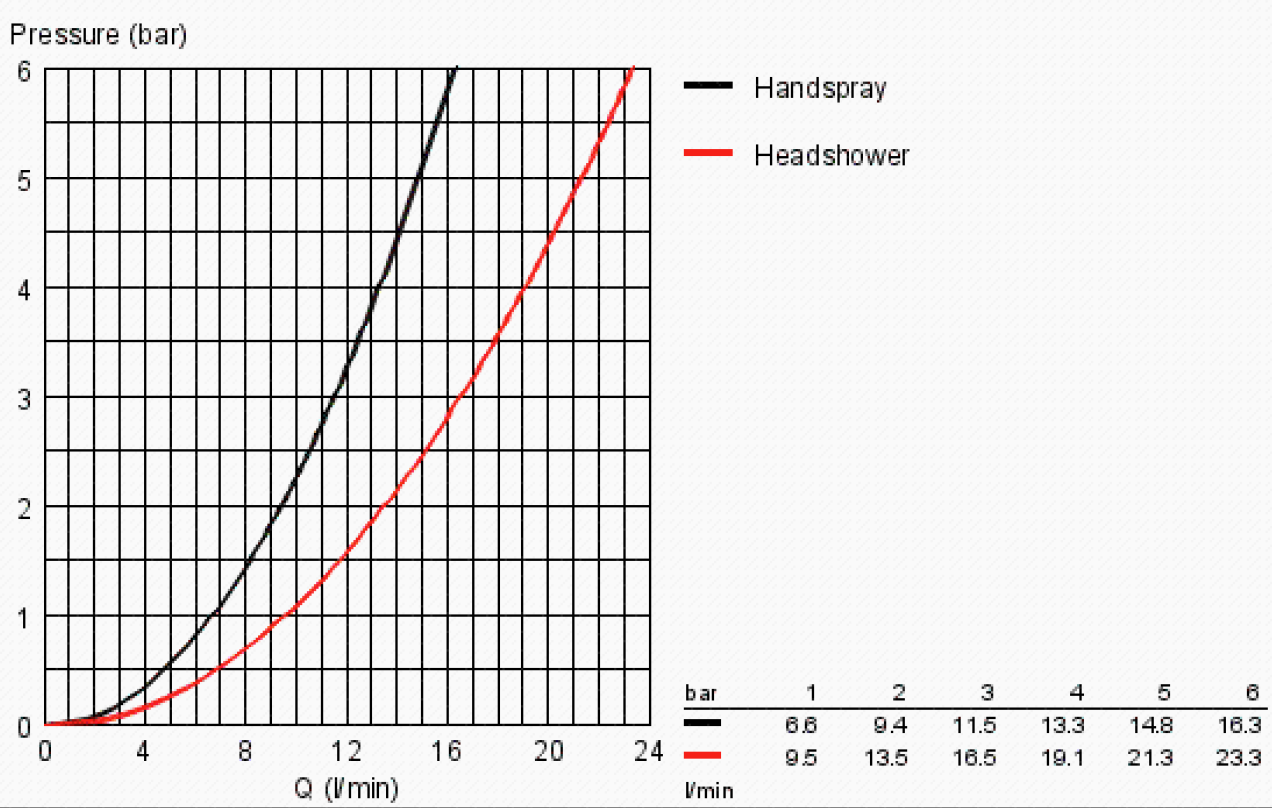
At a pressure of 6 bar (the maximum pressure from the pump) the flow rate is 23.3 l/s. In this case the shower has 2 outlets: a fixed shower head, and, a hand held shower head, which have different flow rates. In such scenarios the larger flow rate should be used.
This can be entered in DEAP 4.3 as follows:
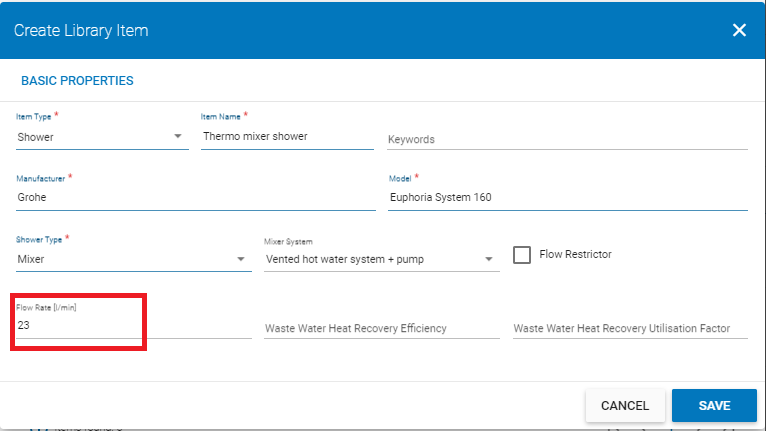
Note that the Flow Rate must be a whole number so 23.3 is rounded to 23 litres/min.

Waste Water Heat Recovery
A waste water heat recovery system uses a heat exchanger to recover heat from waste warm water as it flows through the waste plumbing system. It uses the recovered heat to pre-heat the cold water feed of a shower and a combi boiler or mains pressure hot water system (thermal store or unvented cylinder).
The energy recovered depends on the temperature of the cold water feed to the dwelling and type of systems that are installed.
WWHR systems are accounted for in DEAP 4.3 where they are linked to mixer showers, not for electric showers. There are three types of plumbing arrangements for WWHR systems:
- System A: output of the heat exchanger is fed to both the shower and the combi boiler or hot water system;
- System B: output of the heat exchanger is fed to the shower only;
- System C: output of the heat exchanger is fed to the combi boiler or hot water system but not to the shower.
To account for a WWHR system in DEAP 4.3 the following data is required:
- Efficiency of WWHR: this measures the efficiency of the heat recovery unit;
- Utilisation Factor: this takes account of shut-down and start-up losses. It is expressed as a factor between 0 and 1.
A WWHR system can only be entered in DEAP 4.3 if it is listed on the Product Characteristics Database (PCDB): https://www.ncm-pcdb.org.uk/sap/index.jsp
For each product listed on the PCDB, the data is given for each of the 3 possible system arrangements described: System A, System B, System C.
Example
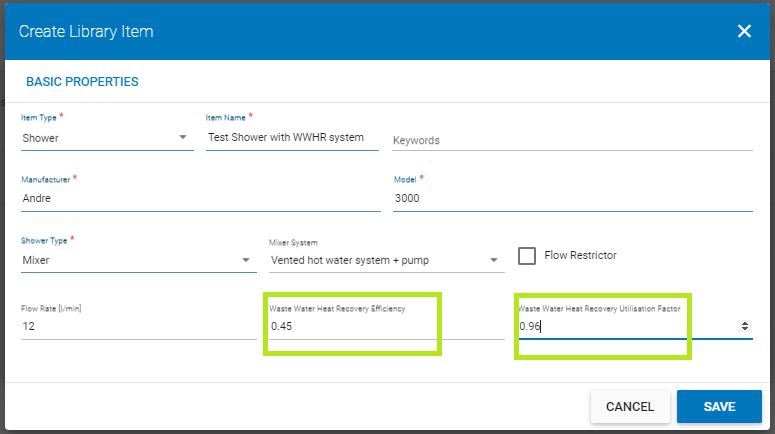
For a New-Provisional BER, the specification, signed-off by the Architect, states that the shower in the main bathroom will use a Megaflo SHRU 60 WWHR system in a “System B” configuration. This system is listed on the PCDB:
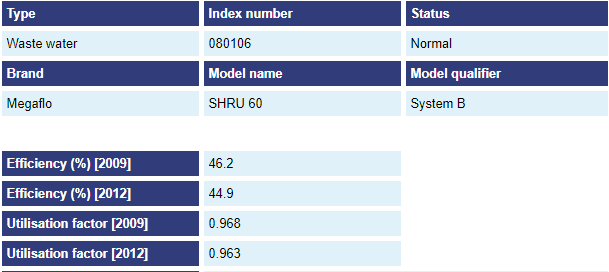
which would be entered in DEAP 4.3 as follows, with the numbers rounded to 2 decimal places
For a New Provisional or New Final BER, the presence of the WWHR system may be substantiated in a specification document signed-off by the architect, engineer, or assigned certifier for the dwelling.
For an Existing BER, the presence of the WWHR system may be substantiated by invoices/receipts that clearly identify the system and dwelling address, or a signed-off statement on headed-paper from the installer detailing the same.