¶ Instantaneous electric water heater
An instantaneous electric water heater is a unit containing an electric heating element used to provide on-demand hot water, i.e. when the hot water tap is opened the electric element is switched on, thereby heating the cold water passing through it. These units are frequently located at the point of use, e.g. under the sink. They may contain a small insulated hot water store to be included in the water storage volume in the Water Heating section in DEAP. If a unit has a water store its volume may be detailed on a product data plate as shown in Figure 5.25.
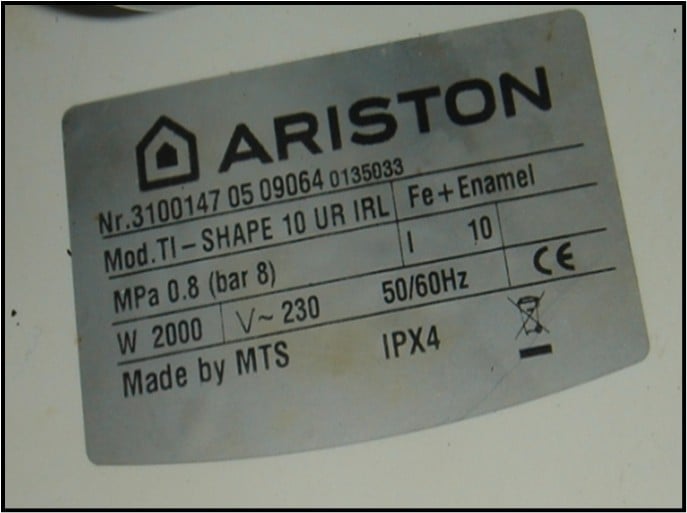
In this case the volume is 10 litres. The data plate must have a CE-mark or reference to a national standard or equivalent to use the volume shown in DEAP. Where insulation thickness isn’t detailed and can’t be measured, the default thicknesses based on dwelling age band from DEAP Table S11 are used. The examples below show how these systems are treated in DEAP.

Example 1
Consider a one-bedroom apartment with hot water provided by three identical instantaneous electric water heaters: one for the bath, one for the bathroom sink, one for the kitchen sink. A CE-marked data plate on the instantaneous heaters states that each unit has a 10-litre hot water store insulated by 15mm of high density polyurethane foam. How is this treated in DEAP?
The hot water storage of each instantaneous heater must be accounted for in DEAP. The DEAP inputs are as follows:
- Water heating tab:
- Are there Storage Losses: “Yes”.
- Water Storage Volume (for the three water heaters): 10*3 = 30 litres.
- Temperature Factor Unadjusted: 0.6 - equivalent to a cylinder heated by an electric immersion as per DEAP Table 2.
- Temperature Factor Multiplier: 1.
- Insulation Type on Water Store: Factory Insulated.
- Insulation Thickness [mm]: 15
- Are there Distribution Losses: “No” – If the heater is at the point of use, there are no distribution losses. If the heater is not at the point of use, e.g. a multi-point electric water heater providing hot water to taps in several different rooms, then there will be distribution losses.
- Is supplementary electric water heating used in summer: “No”.
- Primary Circuit Loss Type: “Electric Immersion heater” – this is chosen when instantaneous electric heaters are the main water heating system.
- Energy Requirements tab:
- Efficiency of main water heating system: 100%.
- Efficiency adjustment factor: 1 (none of the values in DEAP Table 4c apply)
- Main water heating system fuel: Electricity.
¶ Example 2
A detached house has a regular oil boiler and a 110-litre hot water cylinder with a 25mm thick lagging jacket. The house has an extension with a WC with hot water provided by an instantaneous electric heater. A data sheet indicates that the instantaneous heater has an internal 15 litre hot water store with 10 mm of factory-fitted foam insulation. How do you deal with this in DEAP?
The cylinder and the instantaneous heater both store domestic hot water, so both will contribute to the storage loss. However, the main water heater is the oil boiler (provides more hot water and is cheaper to run). DEAP entries are as follows:
- Storage Volume: 110 + 15 = 125 litres.
- Insulation Type & Thickness: only one entry is permitted in DEAP so the weighted average of the two systems must be calculated considering the different storage capacity of each system; so,
- Insulation Type: Factory Insulated.
- Insulation Thickness = (25 x 0.5 x 110) + (10 x 15) = 12.2 = 12mm.
(110 + 15)
Lagging jacket insulation is half as effective as factory foam insulation. Therefore, the 25mm thickness of the cylinder lagging jacket is multiplied by 0.5 in the equation above. The equation shown provides an average factory insulation thickness weighted by volume.
- Temperature Factor & Temperature Factor Multiplier: these are calculated as normal for the main water heating system, i.e. the boiler & cylinder system.