¶ Heating Controls Examples
Control category: common errors
¶ Insufficient Documentary Evidence
The retention of insufficient documentary evidence is often identified as a code of practice non-compliance issue. As detailed here, photographic evidence of heating controls is required.
¶ Control Category Value of “3” Entered in Error for Boiler Systems
One of the most common errors encountered during audit is the selection of control category 3 (time and temperature zone control) where site observations and/or the assessors survey notes do not support this category. As per the definition in the Controls Tab:
“In order to specify time and temperature zone control it must be possible to program the heating times of at least two space heating zones independently in addition to independent temperature controls. It is not necessary for these zones to correspond exactly with the zone division that defines the living area fraction”.
There are two key requirements in the above definition:
- Independent time control of at least 2 space heating zones
- The ability to be able to set the temperature of each of the space heating zones. If only one of these requirements is met, time and temperature zone control cannot be selected in DEAP.
Some examples of typical programmers and timers in dwellings are shown below. The right-hand column of the table describes whether the controller(s) can provide time and temperature control when installed in conjunction with sufficient thermostatic control. Note that some other conditions (as described) may need to be met to constitute time and temperature control.
Table 4.3 - Examples of Programmers and Timers
| Controller | Description | Capable of independent time control of 2 space heating zones? |
|---|---|---|
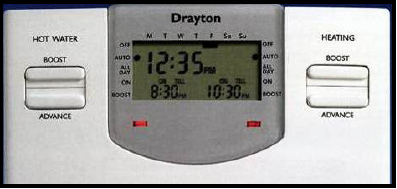 |
Electronic programmer.
|
No. Only one channel is available for control of the space heating. If this is the only time programmer in the dwelling, then time and temperature zone control is not possible regardless of the number of thermostats present. |
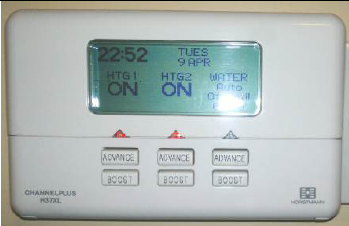 |
Electronic programmer.
|
Yes. 2 channels are available for controlling time for space heating zones. Time and temperature zone control is possible. At least two room thermostats must be present in the dwelling in conjunction with this controller to specify time and temperature control in DEAP. |
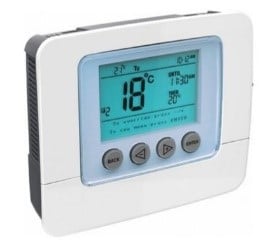 |
1 x Programmable Thermostat. | No. These controllers are often identified as a standard programmer in error. They provide time and temperature control to a single zone. They are often characterised by a grille to the casing to allow air from the room to pass over a thermostat element. If unsure if the device is a programmable thermostat take the model number and attempt to identify the type through an on-line search. If this does not resolve the type contact the Helpdesk for advice. |
|
|
2 x Programmable Thermostats. | Yes. Same controller as above but there are two. It is therefore possible to control both the time and temperature of two zones independently. Time and temperature control can therefore be specified in DEAP. Additional thermostats are not required for time and temperature control as the thermostat is integrated with the programmers. |
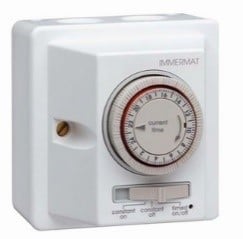 |
1 x Mechanical Timeclock. | No. The timeclock provides time control but only has one channel and is therefore not capable of providing independent time control of two space heating zones. |
|
|
2 x Mechanical Timeclocks |
Yes. Two channels are available for the time control of two space heating zones. Notes: The assessor must be sure that both timers are for the space heating zones, e.g. through labels or the presence of an additional controller that is clearly for control of the domestic hot water. Two mechanical time clocks could be for one space heating zone and domestic hot water. Two room thermostats must be present in conjunction with the timeclocks to specify time and temperature zone control. |

Further control category examples
Information is required from site survey for correct selection of controls in DEAP:
- System/boiler type and emitter type.
- Type of control of space heating.
- Number of zones.
- Number of room thermostats.
- Number TRV’s.
The following examples show the effect of varying time and temperature control on the DEAP entries. Full details are available in Tables 4.6 and 4.8 in particular.
¶ No time control of main space heating
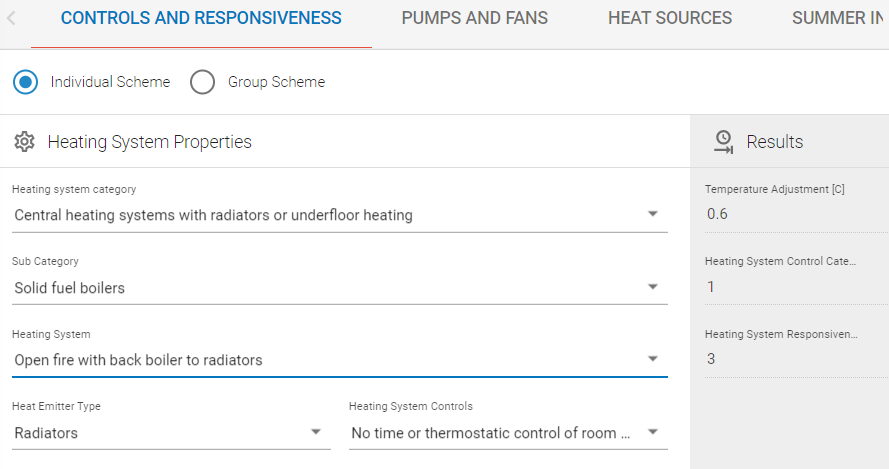
A typical scenario would be when the main space heater is an open fire with back boiler to radiators. It can also be found in boiler systems controlled only by means of an on/off switch or by systems having a room thermostat only. This poor level of control is reflected in the control category of ‘1’ and in some cases a temperature adjustment greater than ‘0’.
¶ Wall or room thermostats
Wall or room thermostats are available in diverse types and styles, analogue and digital, examples of these are shown as follows:
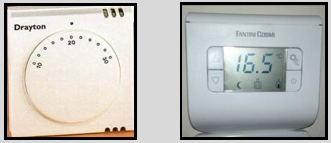
If there are multiple space heating thermostats, then there are multiple space heating zones and each of these will need independent temperature and time control to apply a control category of ‘3’ in a boiler system.
¶ TRV’s
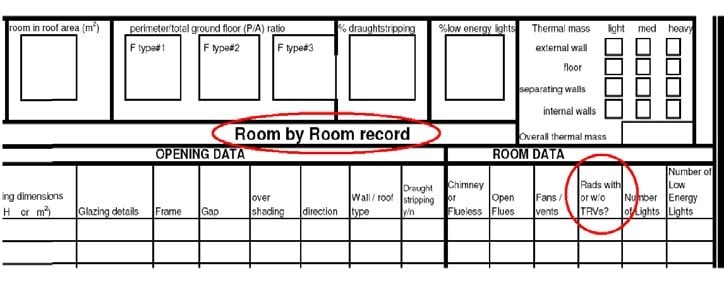
All TRV’s are counted in the Survey Form – Room by Room record. This determines whether they are accounted for in DEAP. A programmer is always needed for TRVs to be considered as control category ‘2’.
¶ Group Heating Controls
For selection of the appropriate control category, observe and record the presence of the programmer, thermostats and TRVs. The programmer can be in the dwelling (e.g. apartment) or central to the group heating scheme (e.g. boiler room, corridor). As stated in Table 4.8, Group 3; under heating controls: "(Programmer in group heating scheme may be inside dwelling or part of the group heating system)".
¶ Electric Heater Controls
Consider a small apartment with a storage heater and Automatic Charge Control in the living room and direct electric heating (with on/off control only) in each of the two bedrooms. There are no other habitable rooms. As per the primary and secondary heating systems guidance, the direct electric heaters heat most of the habitable rooms and are therefore the main heating system. The controls in DEAP are as follows:
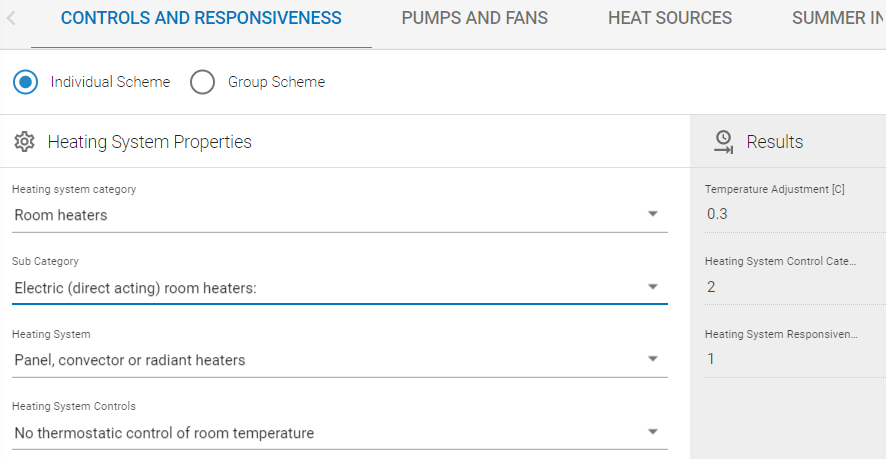
If an appliance or system of appliances can provide the level of time control outlined in the heating controls section, it should be considered as a programmer.
The Heating Controls Section defines a Room thermostat as follows: ‘A room thermostat senses the indoor air temperature and switches on or off the space heating. A single target temperature may be set by the user.'
An Appliance Thermostat is located on the appliance and again, the user must be able to set a single target temperature. The following photo shows an appliance dial graduated by '*' to 'Max' on a direct electric heater:
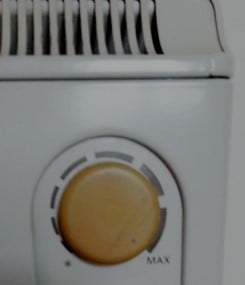
This cannot be used to set a specific target temperature and therefore should not be regarded as a thermostat.
Alternatively, there may be product instructions or literature available for this appliance equating the graduations to temperatures measured in the room. We would advise Assessors to contact the relevant supplier/manufacturer for further details and to contact the Helpdesk if further assistance is needed.