¶ Heating system efficiency
DEAP assumes that the dwelling has heating system(s) capable of heating the entire dwelling. Calculations are based on a main heating system and secondary heaters as described in DEAP Appendix A. This Appendix also covers whether secondary heating is to be specified in DEAP. The apportionment of heat supplied from the main and secondary systems is given in DEAP Table 7.
As detailed in DEAP Manual Section 9, gross seasonal boiler efficiency can be taken from any one of the following sources:
- HARP database - this is the preferred option;
- Certified test data. Follow guidance in Appendix D/J/E/G of the DEAP manual to convert to gross seasonal efficiency for use in DEAP;
- Defaults in Table 4a and Table 4b in the DEAP manual.

Example 1: Converting to Gross Efficiency
- Test certificate for wood fuel stove: net efficiency 77.2%.
- Stove warranty states that only wood fuel may be used in the appliance.
- Efficiency conversion factor for wood fuels is 0.91 (DEAP Manual Table E4)
- The efficiency used in DEAP is given by: Gross efficiency = 77.2 x 0.91 = 70.25%.
Where an appliance does not have the exact same name as an appliance on HARP/certified data or the full name is not visible on the appliance, HARP/certified data can be used if one of the following is available and clearly equates the appliance in the dwelling to a HARP/certified data entry:
- Appliance installation manuals or instruction manuals;
- Statement on printed letterhead (in softcopy or hardcopy) from one of:
- appliance manufacturer;
- appliance supplier;
- service engineer or maintenance firm.
The examples below deal with the correct identification of boiler efficiency based on the evidence available.

Example 2
Example 2.1:
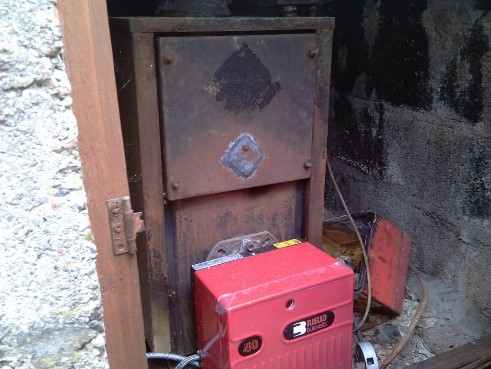
The oil boiler recorded on site had no visible make or model number. There is no brochure or user manual available. It was determined that the house was built in 1997. As there is no further evidence available it is necessary to use the default efficiency from DEAP Manual Table 4b for a standard oil boiler 1985 to 1997 of 70%.
Example 2.2:
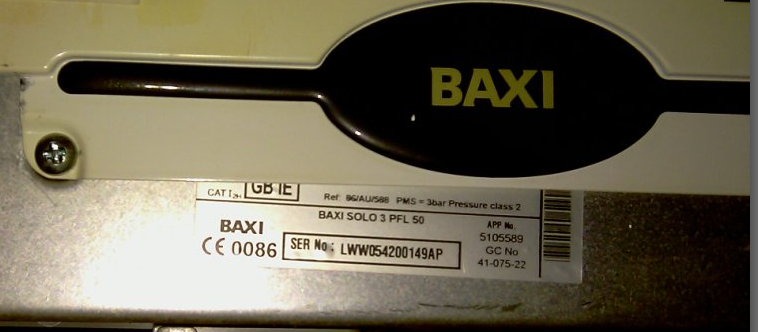
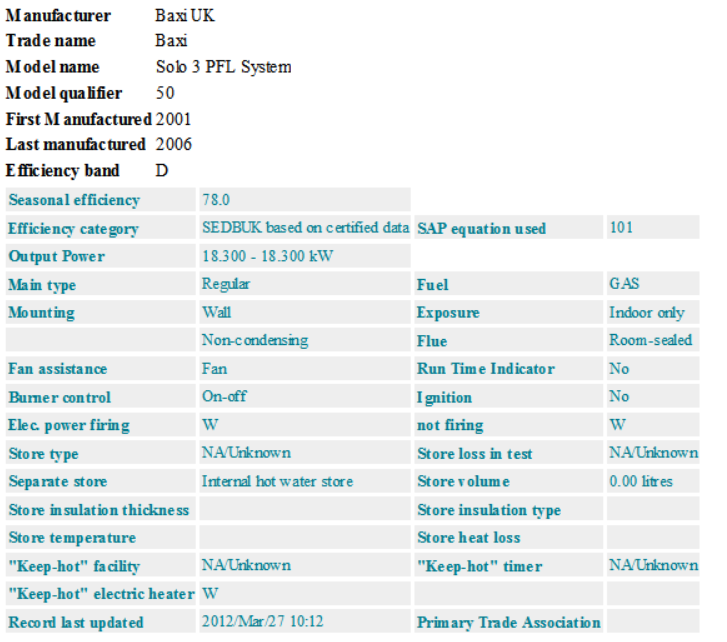
A Baxi Solo 3 PFL 50 Mains Gas boiler was identified on site on a data plate on the boiler’s external casing. This gas boiler has an efficiency of 78% on the HARP database as shown.
¶ Example 3
The main heating system in a semi-detached dwelling built in 1999 is a Sirrus Radiant Combi gas boiler with automatic ignition. There is a condensate drain from the boiler indicating the type of boiler as a condensing boiler. The boiler has a flow and return pipe for space heating as well as a mains water inlet and DHW outlet as you would expect for a combi boiler. The boiler is fuelled by Mains Gas and is wall hung. The boiler provides all space heating to all habitable rooms as well as water heating. There is no detail available on the model type of the boiler. There is a two-channel programmer controlling both water and space heating. There are no fixed secondary heaters in place.
Sample image of condensate drain on a gas boiler
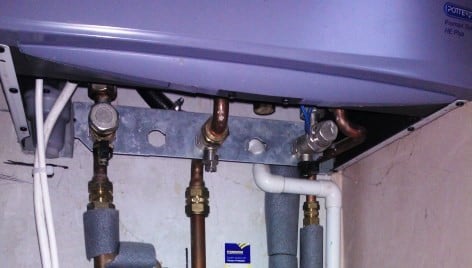
As there are no other details available on the type of gas boiler a default efficiency of 83% for “condensing (including combi) boilers with automatic ignition” is applied to the gas boiler (1998 or later) from DEAP Manual Table 4b.
The following data entry applies for DEAP:
| Heating System | Heating System Type | Fuel Type |
|---|---|---|
| Main Space Heating System | Condensing Gas Combi Boiler | Main Gas |
| Secondary Space Heating System | None | None |
| Main Water Heating System | Condensing Gas Combi Boiler | Main Gas |
| Supplementary Water Heating System | None | None |
As there are no fixed secondary heaters in place and all habitable rooms are heated by the main space heating system ‘None’ is selected for the Secondary Space Heating System. There is separate zoned time control (DHW separate from space heating). Therefore “None” is selected for Supplementary Electric Water Heating. See Section 4.6 of the DEAP manual for further guidance on Supplementary Water Heating.
¶ Example 4
A single storey dwelling built in 1930 located in Dublin has five habitable rooms with the following:
- 1 single burner dry heat range cooker in kitchen/diner with a discrete seating area.
- 1 open fire in living room
- 1 open fire in one bedroom
- 2 bedrooms not heated
There are no radiators in the house. There is no water heating system in the house.
Note: Single burner dry heat range cooker: DEAP Manual Appendix B Section 4.3 specifies this type as an appliance with a single burner that provides a cooking function. It is not included in DEAP calculations1. The kitchen/diner is therefore assumed to be unheated.
The DEAP methodology assumes that a good standard of heating is achieved throughout the dwelling. For dwellings in which the heating system is not capable of providing the standard, it is assumed that the additional heating is provided by electric heaters as detailed in DEAP Appendix A2. For new dwellings that have no heating system specified, DEAP assumes that all heat is provided by electric heaters. See A2 and A3 in the DEAP manual for full details of how to assess an unheated, partly heated or fully heated dwelling.
In the case above, of the 5 habitable rooms, 40% are heated by an open fire room heater, 60% are unheated. As per DEAP Manual A3.2 – 'If the number of habitable rooms actually heated is more than 25% but not exceeding 50%, and there is one type of heater installed, this heating system is the primary and the (assumed) electric heaters are the secondary. Where there is more than one type of heater installed in this case, Sections A1 and A2 apply when identifying the primary and secondary space heating systems'.
The following data entry therefore applies for DEAP:
Table 4.16 - Data entry for heating systems
| Heating System | Heating System Type | Fuel Type |
|---|---|---|
| Main Space Heating System | Open fire | Manufactured Smokeless Fuel |
| Secondary Space Heating System | Electric Room Heater (assumed) | Electricity |
| Main Water Heating System | Electricity | Electricity |
| Supplementary Water Heating System | None | None |
Where a dwelling has no water heating system present, direct electric water heating is assumed to meet the hot water demand. In this case, supplementary electric water heating is not specified as the main water heating is an electrical heat source. If there is no cylinder present, then hot water storage losses are not specified.