¶ Sheltered sides
A side of a building is sheltered if there are adjacent buildings or hedges/trees obstructing the wind on that side of the building. This applies at the time of the assessment (or the expected time of dwelling completion for provisional assessments).
A side should be considered sheltered if all the following apply:
- the obstacle providing the shelter is at least as high as the ceiling of the uppermost storey of the dwelling;
- the distance between the obstacle and the dwelling is less than five times the height of the obstacle;
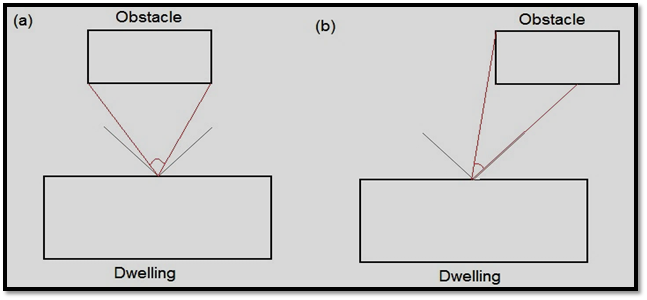
- the width of the obstacle (or the combined width of several obstacles) subtends an angle of at least 60° within the central 90° when viewed from the middle of the wall of the dwelling that faces the obstacle - see Figure 5.3. Where the obstacle is very close to or adjoining the dwelling side (for example, an adjoining unheated outhouse), the object should be the same height as the dwelling and at least half the width of that dwelling side. Where there is more than one obstacle providing shelter on a single side, their width can be combined to subtend the aforementioned 60° angle.
Any party wall should be counted as a sheltered side once it meets the criteria above.
Figure 3.7 - Sheltering angle
¶ Partially Sheltered Sides
Two partially sheltered sides should be counted as one sheltered side. Architectural planting does not count as shelter unless it actually exists (even though shown as mature trees on drawings). If a tree of sufficient height and width is present it is considered as potentially sheltering the house, whether the tree has leaves or not.
The relevant base level for a sheltering obstacle starts at the base level of the dwelling being assessed. For example, a top floor apartment can only be sheltered by obstacles higher than the lowest floor of the apartment and obstacle height below that is ignored.
Obstacles can also be “combined” if they are close enough and wide enough but not tall enough. For example, consider a two-storey detached house with the upstairs ceiling at a height of 5.5 metres. The house is surrounded by a 3-metre tall hedge that is 4 metres from the house.
Figure 3.8 - Combining sheltering sides
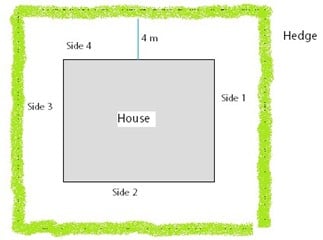
If two sides are taken together, the combined hedge height is 6 metres which is tall enough as it is greater than the dwelling height. So, sides 1 and 2 count as a single sheltered side, as do sides 3 and 4. In total the house has 2 sheltered sides in DEAP.