¶ Solar Heating
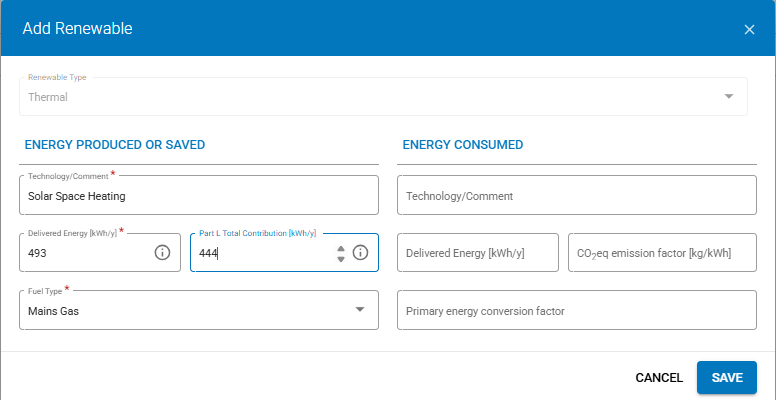
The solar water heating section in the Hot Water tab provides detailed guidance on solar water heating. The guidance below elaborates on the space heating aspect of Solar heating.
¶ Solar space heating in individual heating systems
Solar space heating for individual heating systems is accounted for in DEAP using the method defined here (under “DEAP Tools and Information”).
Examples
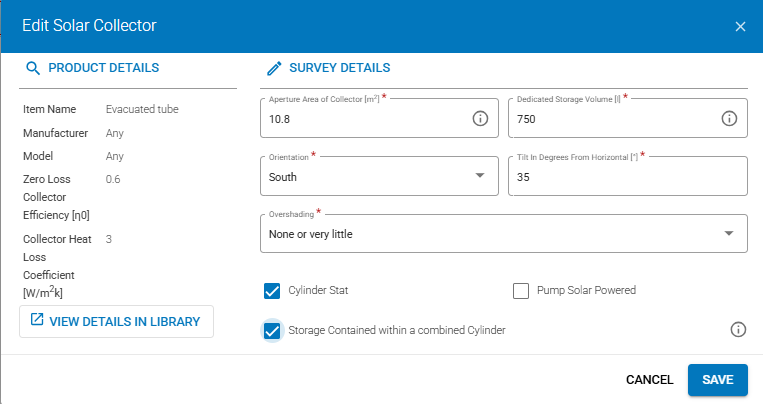
A new dwelling has 15m2 (gross area) of evacuated tube solar collectors providing some of the space and water heating demand. For simplicity, the data for the solar collector is taken from Table H1 of the DEAP manual, although data listed on HARP should be used if available for the collector product in question. The solar panels are south-facing at an angle of 30° with no overshading.
The hot water cylinder is a 1000 litre dual coil cylinder with a Dedicated Solar Storage Volume of 750 litres and 100 mm of factory-applied foam insulation. 1
To carry out this calculation, follow the Solar Space Heating (individual systems) guidance and associated calculator at the link above. The first step is to calculate the amount of heat collected by the solar panels that will be used to reduce the water heating load. This is done by entering the information on the solar heating system into DEAP in the usual way.
DEAP calculates the Solar Hot Water Input, Qs = 2459 kWh/year.
The next step is to calculate the amount of heat collected by the solar panels that will be used to reduce the space heating load. This is the surplus heat from the collectors during the heating season and is calculated by entering the following information into the Solar Space Heating spreadsheet.
----------------------------------
1 Typically, solar space heating systems will have larger solar collector area to produce surplus heat for some of the space heating season above the hot water requirement. Therefore, they require larger storage systems. In solar space heating systems, the “hot water solar fraction” would usually be above 60% as calculated in the Water Heating section of DEAP.
----------------------------------
- Total Hot Water Heating Demand: this value, in kWh/y, is copied from the Water Heating tab of DEAP.
- Water Storage Volume: in litres, copied from the Water Heating tab of DEAP. In this case it has a value of 1000 litres, as mentioned above.
- Annual Space Heating Requirement: in kWh/y, copied from the View Assessment > Gains/Losses section in DEAP.
- Adjusted Efficiency of Main Heating System: taken from the View Assessment > Energy section of DEAP. Note that this is the adjusted efficiency accounting for the effect of heating controls.
The next step depends on the type of solar space heating system. The Solar Space Heating spreadsheet covers two types:
- Systems with a cylinder or thermal store for storing the solar heat for both water and space heating.
- Systems with a cylinder for water heating only and with solar space heat supplied immediately to the heated space in the form of warm air.
In the calculation spreadsheet, select the appropriate system from the dropdown list and follow the final steps set out in (1) or (2) below:

Case 1: Systems with a cylinder for storing the solar heat for both water and space heating.
For this type of system, the details of the solar heating system are entered into the spreadsheet. The information is the same as that already entered in DEAP.
The spreadsheet then calculates the Space Heat Contribution – the renewable contribution to part L from the system - and the Delivered Space Heating Energy Saved which must be used to account for the system in DEAP.

This data is entered in DEAP in the Energy requirements – Fuel Data tab as shown below:
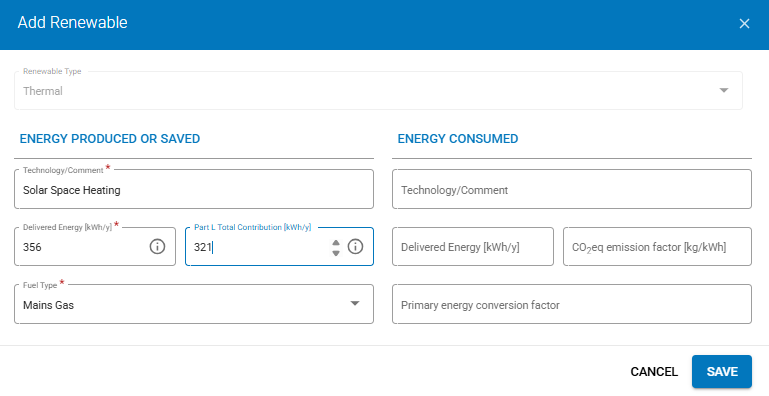
The ‘Primary energy conversion factor’ and ‘CO2 emission factor’ are for the main space heating fuel in the dwelling.
¶ Case 2: Systems with a solar store for water heating only and with solar space heat supplied immediately to the heated space in the form of warm air.
In this case the following data must also be entered in the “Immediate” worksheet of the Solar Space Heating spreadsheet:
- Total Floor Area: from the Building > Floors tab of DEAP.
- Total Heat Loss: from Results tab in the DEAP Survey.
- Thermal Mass Category of Dwelling: from the Building > Global Factors tab of DEAP.
As before, the spreadsheet calculates the Space Heat Contribution and Delivered Space Heating Energy Saved,

which are entered into DEAP as shown in this diagram: