¶ BER grade not as expected
A dwelling designed to comply with Building Regulations 2011 TGD L would be expected to achieve an A on the Building Energy Rating scale. Dwellings designed to comply with earlier editions of the Building Regulations TGD L would not be expected to achieve better than a B rating. The national average BER grade is a D rating with variation depending on dwelling age, insulation, heating system efficiency, fuel, etc. The Central Statistics Office provide some analysis of BERs based on a number of parameters to help estimate a typical BER grade for the dwelling type/age. An example is shown in Figure 12.1.
Figure 12.1 - BER distribution statistics
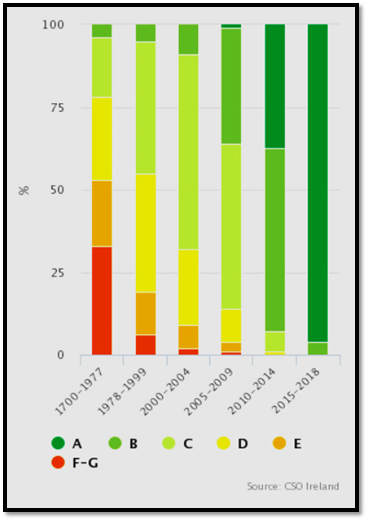
If the BER achieved is better or worse than expected, it is possible that one or more errors have been made in the assessment. Errors must be corrected prior to publication of the assessment on NAS. A common cause of a BER assessment showing a better than expected energy rating for the dwelling is that the heating system has not been entered correctly in DEAP. All errors are taken into consideration by SEAI’s Quality Assurance and Disciplinary Procedure (QADP) regardless of whether they improve or worsen the rating.
The National Administration System (NAS) and DEAP carry out basic checks on data entered to identify likely errors in data entered. The outcomes of these checks must be reviewed by BER Assessors prior to publication of BERs.