¶ Cooling in DEAP

Introduction
Data entry for cooling systems in DEAP has been designed to be as simple as possible, Assessors are only required to enter system details and fuel type. The SEER is defaulted to 2.5.
The DEAP calculation assumes that where a cooling system is present in a dwelling, it provides cooling from June to August. It assumes the dwelling is cooled intermittently - 6 hours per day. As with the heating calculation in DEAP, the cooling requirement is based on monthly calculations taking account of the heat losses and gains in the dwelling.
The Delivered Energy calculated in DEAP accounts for the Seasonal Energy Efficiency Ratio (SEER) of the cooling system.
The overall effect of cooling on the BER is likely to be small, largely because of the moderate Irish climate.
Guidance on re-use of data for Cooling can be found here
¶ Systems assumed to provide cooling in DEAP
In DEAP, a warm air heat pump system is assumed to be reversible and capable of providing cooling. The following system types meet this definition:
- Air-to-air heat pump,
- Brine-to-air heat pump,
- Exhaust air-to-air heat pump.
Where such a system is present in a dwelling, then its cooling function must generally be accounted for in the BER.
The cooling function of such a system can only be disregarded where it can be shown that the system is not providing cooling. The supporting evidence required to ignore the cooling function is as follows:
- The Designer/Installer form should indicate that cooling is not provided by the system;
- The Designer/Installer must provide a signed-off statement indicating how the Cooling function has been disabled (or is not available in the product) with specific reference(s) to the manufacturer’s instruction manuals.
Note that any such system is also assumed to be capable of providing heating and should be considered in determining the primary and secondary space heating systems in the dwelling.
¶ Systems assumed not to provide cooling
For heat pumps providing heating via wet systems, e.g. using radiators or underfloor heating, it should be assumed that there is no cooling present, unless otherwise specified by the design/installer in their sign-off.
If the BER assessor comes across other evidence indicating that such a system may be reversible and used for cooling, they should contact the helpdesk for specific advice.
¶ Energy for cooling
Energy for cooling is calculated for dwellings with a fixed cooling system installed (that is air conditioning or heat pump providing cooling). The calculation derives the net space cooling requirement and accounts for the impact of thermal mass on heat losses as offset by gains. The cooling system is assumed to operate for six hours per day, maintain an internal temperature of 24°C for the months of June, July, and August. The resulting energy requirement is calculated by DEAP based on this net space cooling requirement, the seasonal energy efficiency ratio (SEER) of 2.5, and the fuel used, as entered by the user. The calculation is carried out according to the EPBD overarching CEN standards (EN ISO 52016-1:2017).
Notes:
- Cooling systems can be powered by electricity, mains gas or LPG.
- If a cooling system heat pump can also operate in heating mode, it is considered a heat pump heating system in DEAP subject to the guidance in DEAP.
- A warm air heat pump (e.g., air to air, brine to air, exhaust air to air) is assumed to be reversible and to also provide cooling. If the cooling function in a specific product or system is not available, evidence must be provided of how the function has been disabled or is not available in the product, as per the DEAP Survey Guide. For hydronic heat pumps (e.g., using radiators or underfloor heating), it is assumed that there is no cooling present, unless otherwise specified by the designer.
¶ Identification of -to-Air systems
Air-to-air systems are relatively uncommon in domestic scenarios in Ireland but are the most likely cooling system an Assessor would encounter.
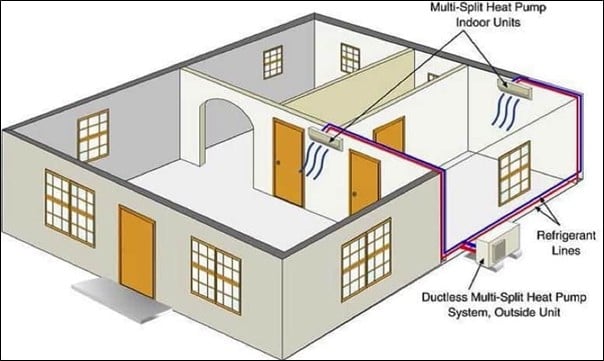
A typical air-to-air system arrangement is shown in Figure 6.1 below.
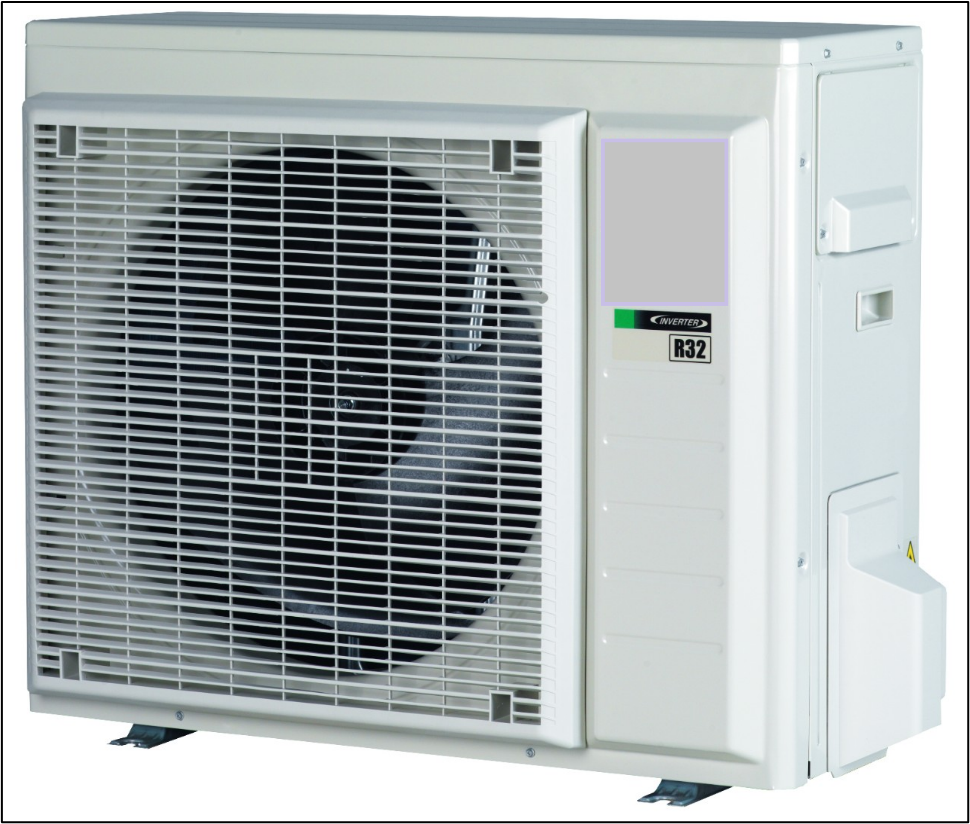
An air-to-air system has an outdoor unit (Figure 6.2), which can extract heat from the surrounding air (for heating) or can emit heat to the surrounding air (for cooling).
Air-to-air systems usually have one or more indoor units which deliver heated or cooled air to the dwelling. The outdoor and indoor units are connected by refrigerant pipework.
There are several types of indoor unit available as shown in images below:
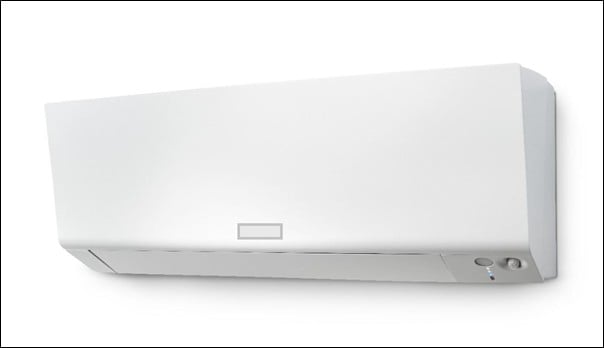
This is a wall unit usually located high on the wall. It uses fans to efficiently distribute the warmed or cooled air throughout the room.
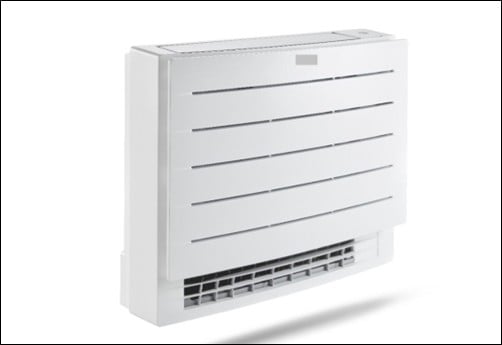
This is a wall unit typically located low on the wall, similar to the location of a wet system radiator. Again, it uses fans to distribute the warmed or cooled air throughout the room.
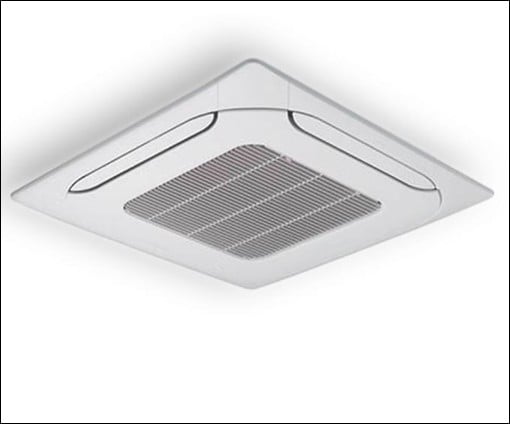
Figure 6.5 is the type of unit mounted in the ceiling. These units are common in non-domestic settings but are available for dwellings too.
There are other arrangements possible – for example, a ducted air-to-air system capable of providing cooling – but heat pump systems using air as the distribution medium are still relatively uncommon in Ireland.
If the BER assessor comes across a system other than those described here, that may be reversible and used for cooling, they should contact the helpdesk for specific advice.