¶ Gas and oil boiler systems, boilers with a thermal store, and range cooker boilers

Boilers in the database
The HARP database contains, in addition to efficiency, all the boiler parameters relevant to DEAP calculations. The Seasonal Efficiency of Domestic Boilers UK (PCDB) Database, 2005 version (formerly SEDBUK), is no longer to be used as a source of non-default boiler efficiency data.
¶ Gas and oil boiler systems in Table 4.5
General definitions of the various modern boiler types are given in Appendix D. Table 4.5 gives gross seasonal efficiency values for use when the HARP value is not available. The following provides guidance for the categories in Table 5.1 and Table 4.4/Table 4.5.

Combination boilers
Table 4.5 does not distinguish between the sub-types of combination boiler, and the values given for ‘combi’ apply to all sub-types (on/off or modulating, instantaneous or storage).
For definitions of storage combination boilers see here. A combination boiler with an internal hot water store may be either:
- Primary: a primary water store contains mainly water common with the space heating circuit;
- Secondary: a secondary water store contains mainly water directly usable as domestic hot water.
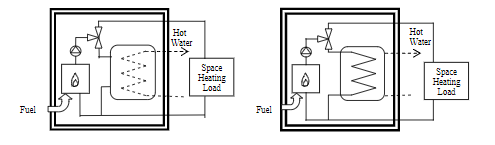
The main difference between a combined primary storage unit CPSU and a storage combination boiler with a larger primary store is that in a CPSU the feed to the space heating circuit is taken from the store, while in a storage combi with a larger primary store, the store does not feed the space heating circuit.

Boilers 1998 or later
If the ignition type is not known, a boiler with a fan-assisted flue may be assumed to have automatic ignition, and one with an open flue to have a permanent pilot light.

Boilers with fan-assisted flue
‘Low thermal capacity’ means a boiler either having a copper heat exchanger or having an internal water content not exceeding 5 litres. If the position is uncertain the category of ‘high thermal capacity’ should be used.

Boiler selected by date
The date refers to the year of manufacture of the boiler. If this is uncertain the older category should be used.

Combined Primary Storage Unit (CPSU)
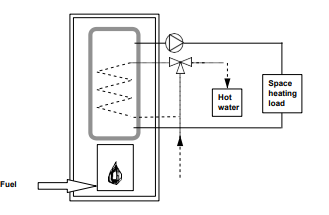
A CPSU is defined here. The store must be at least 70 litres - if the store is less than 70 litres, the appliance should be treated as a storage combination boiler. A schematic illustration of a CPSU is shown in Figure B2.
Note: If the store is a different appliance from the boiler (for example, if it is contained within a separate overall casing) the system should be treated as a boiler with a thermal store.
Boilers with a thermal store
All systems described in this section have hot water stores as a separate appliance from the boiler.

Integrated thermal store
An integrated thermal store is designed to store primary hot water directly for space heating and indirectly for domestic hot water. The heated primary water is circulated to the space heating (radiators). The domestic hot water is heated instantaneously by transferring the heat from the stored primary water to the domestic hot water flowing through the heat exchanger. A schematic illustration of an integrated thermal store is shown in Figure B3.
For an appliance to qualify as an integrated thermal store, at least 70 litres of the store volume must be available to act as a buffer to the space heating demand.
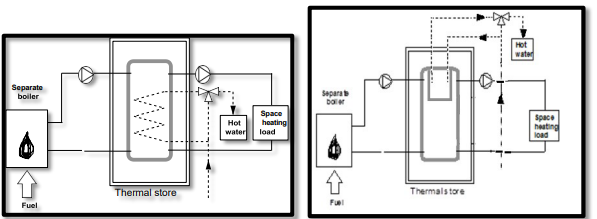
Tank in tank storage units such as in the second diagram above are also considered as thermal stores in DEAP. A tank in tank arrangement would typically have a larger tank heated directly by the heat source and provides heat directly to the space heating load. They also contain a smaller tank of domestic hot water within the larger tank. The heat loss storage volume entered in DEAP in this case is the sum of the large tank and the smaller tank therein.

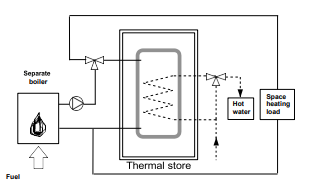
Hot water only thermal store
A hot water only thermal store is designed to provide domestic hot water only and is heated by a boiler. The domestic hot water is heated by transferring the heat from the primary stored water to the domestic hot water flowing through the heat exchanger, the space heating demand being met directly by the boiler. A schematic illustration of a hot water only thermal store is shown in Figure B4. The hot water storage volume includes the large tank and any smaller coil or tank therein.
¶ Range cookers (oil, gas, LPG, and solid fuel)
Range cookers are flued cooking appliances predominantly constructed of cast iron designed to provide some heat from their case into the space where they are located. There are three types:

Range cooker with boiler for space heating
This type provides an independent water heating function for space heating in addition to the cooking function. There are two design variations:
- Twin burner range cooker/boiler – an appliance with two independently controlled burners, one for the cooking function, one for the water heating function for space heating (using radiators for example);
- Single burner range cooker/boiler – an appliance with a single burner that provides a cooking function and a water heating function for space heating (using radiators for example).
For the twin burner type, the gross seasonal efficiency can be from the HARP database, certified data, or Table 4.4/Table 4.5.
For the single burner type, the gross seasonal efficiency should be obtained from Table 4.4/Table 4.5.

Single burner range cooker/water heater
Some ranges provide a cooking function and some or all domestic hot water without providing space heating. Such a range can only be specified as a water heater if the water heating function can be provided independently from the cooking function. The efficiency is taken from Table 4.4. If it is unclear whether cooking and water heating are independent, the range should not be included.

Single burner dry heat range cooker
This type is an appliance with a single burner that provides a cooking function. It is not included in DEAP calculations.