¶ Combi-boilers
A Combination Boiler, commonly known as a combi boiler, has the capability to provide domestic hot water directly and to provide space heating in the usual manner.
In some cases, the combi boiler has an internal hot water store. In DEAP,
- A combi boiler with an internal store capacity of less than 15 litres is classed as an instantaneous combi.
- A combi boiler with an internal store capacity of 15 to 70 litres is classed as a storage combi boiler.1
Dwellings with combi boilers are unlikely to have hot water storage installed other than storage which may be in the boiler. In addition, the combi boiler has separate connections for water and space heating. The HARP database categorises boilers as being combi or regular boilers. In addition, HARP provides information on any storage facility or keep-hot facility in the boiler. This information may also be available from product literature or websites.
When providing hot water, combi boilers operate in response to a demand from a tap or shower. By contrast, a regular boiler heats water stored in a hot water cylinder or thermal store for use later.
It takes a short amount of time for the water leaving the combi boiler to reach an adequate temperature. The energy required to meet the dwelling’s hot water demand in DEAP does not take account of the energy used as the combi boiler output reaches an adequate temperature. In DEAP this extra energy input is called the additional loss for the combi boiler and is specified in DEAP Table 5.4 and the associated footnotes. The Assessor selects the combi boiler type from the list provided in DEAP:
- Instantaneous, without keep-hot facility
- Instantaneous, with keep-hot facility controlled by time clock
- Instantaneous, with keep-hot facility not controlled by time clock
- Storage combi boiler - store volume ≥ 55 litres
- Storage combi boiler - store volume V < 55 litres
1 See DEAP Manual Appendix D for definitions of the combi boiler, instantaneous combi, storage combi and keep-hot facility. Storage > 70litres is a CPSU.
Guidance on re-use of data Water heating: Combi boiler can be found here

Combi Boiler Additional Losses
The additional loss for a storage combi boiler depends on the volume, V, of the internal hot water store.
An additional loss of zero applies if the volume is 55 litres or more (DEAP Table 5.4).
If the volume is less than 55 litres (but greater than 15 litres) the additional loss is calculated by the Assessor for entry in DEAP as follows:
Additional Loss = 600 – [ (V-15) * 15 ]

Example
What is the Additional Loss of a combi with an internal hot water store having a capacity of 45 litres?
V = 45 litres. Substituting into the equation above gives additional loss as follows:
= 600 – [ (45-15) * 15 ]
= 600 – [ 450 ]
= 150 kWh/y.
Table 5.4, note (a) applies to this category of storage combi boiler.
Note (a) states that if the daily hot water usage is less than 100 litres/day, then the additional loss calculated above is multiplied by
(Daily Hot Water Usage)/100.
In this example, if the daily hot water usage is 79 litres/day, the additional loss is corrected to:
= 150 * (79/100)
= 118.5 kWh/y.
The daily hot water usage is displayed on the Water Heating tab in DEAP. If Note (a) applies the Assessor must make the adjustment to the additional loss. This adjustment is not required if the daily hot water usage >= 100 litres.
¶ Table 5.4 (formerly Table 3a) - Additional losses for combi boilers
| Combi type | kWh/year |
|---|---|
| Instantaneous, without keep-hot facility* |
600 a) |
| Instantaneous, with keep-hot facility controlled by time clock |
600 |
| Instantaneous, with keep-hot facility not controlled by time clock |
900 |
| Storage combi boiler** store volume ≥ 55 litres |
0 |
| Storage combi boiler** store volume V < 55 litres |
600 – [(V – 15) × 15] a) |
a) If the hot water usage is less than 100 litres/day, multiply by (daily hot water usage) / 100
* “keep-hot facility” is defined below. The facility to keep water hot may have an on/off switch for the user, or it may be controlled by a time switch. If the store is 15 litres or more, the boiler is a storage combination boiler.
** “storage combi boilers” are defined in Gas and Oil systems in Section 4.
Notes:
In the case of keep-hot:
- If the keep-hot facility is maintained hot solely by burning fuel, use an appropriate loss for combi boiler from Table 5.4 and proceed with the calculation as normal.
- If the keep-hot facility is maintained by electricity, use the following approach:
a) enter the appropriate combi loss from Table 5.4 in the ‘Water Heating: options and storage’ tab;
b) enter appropriate electricity consumption from Table 4.9 in the Water Heating: options and storage tab;
- In the case of an untimed electrically powered keep-hot facility where the power rating of the keep-hot heater is obtained from the HARP database, the loss should be taken as:
Loss =8.76 x P (kWh/year)where P is the power rating of the heater in Watts
- The DEAP software will automatically add the fuel use (in other words, the additional combi loss minus any associated electricity consumption) to the fuel required for water heating, and account for the electricity consumption separately.
Source: SAP 2005
¶ Instantaneous Combi Boilers - Keep-hot facility
Some instantaneous combi boilers maintain the water in the internal store above a set temperature even when there is no hot water demand and the boiler is not in use. This is called a keep-hot facility. It may operate by burning fuel or by heating an electrical element in the internal store. When an instantaneous combi boiler is selected from the list of combi boiler types it is also necessary to specify whether there is a keep-hot facility powered by electricity, using the second drop-down list:

- If there is no keep hot facility present, then the “Electric keep hot facility type” entry is set to “None
- An instantaneous combi with no keep-hot facility has an additional loss of 600 kWh/y but Note (a) applies in this case so the daily hot water usage is considered. DEAP does this automatically. The associated electricity consumption is zero as there is no keep-hot facility.
- If there is a keep hot facility present that operates by burning boiler fuel the “Electric keep hot facility type” entry is set to “None”.
- In this case the additional loss is 600 kWh/y if the keep hot facility is controlled by a time-clock but 900 kWh/y if it is not controlled by a time-clock. The associated electricity consumption is zero. DEAP then attributes the keep-hot facility energy usage to the main water heating fuel type.
- If there is an electric keep hot facility present, then one of the following options is chosen:
- Electric keep-hot facility, controlled by time clock: For an instantaneous combi boiler with an electric keep-hot facility controlled by a time-clock, the additional loss is 600 kWh/y and the electricity consumption is also 600 kWh/y (as defined in Table 4.9).
- Electric keep-hot facility, not controlled by time clock: For an instantaneous combi boiler with an electric keep-hot facility controlled by a time-clock, the additional loss is 900 kWh/y and the electricity consumption is also 900 kWh/y (as defined in Table 4.9). As per the footnotes in DEAP Table 5.4, if the power rating of the keep-hot facility without time clock is available from the HARP database, the additional loss is calculated by the user as:
Loss =8.76 x P (kWh/year)where P is the power rating of the heater in Watts. The electricity consumption will have the same value as detailed in DEAP Table 4.9 (note f).
¶ Table 5.5 - Losses for Combi-boiler Keep-Hot Facility
| Keep hot Facility | Type | Timeclock | Additional Loss (kWh/y) | Electricity Consumption (kWh/y) |
|---|---|---|---|---|
| No | NA | NA | 6002 | 0 |
| Yes | Boiler Fuel | No | 900 | 0 |
| Yes | Boiler Fuel | Yes | 600 | 0 |
| Yes | Electric | No | 900 or (8.76 x P) | 900 or (8.76 x P) |
| Yes | Electric | Yes | 600 | 600 |
2 Table 3 Note (a) applies in this case if daily hot water usage < 100 litres.
¶ Further examples of combi boilers in DEAP
The examples below show population of DEAP fields for both instantaneous and storage combi boilers.
Example 1 – Instantaneous combi boiler
The screen shot below shows the HARP listing for an instantaneous combi boiler.
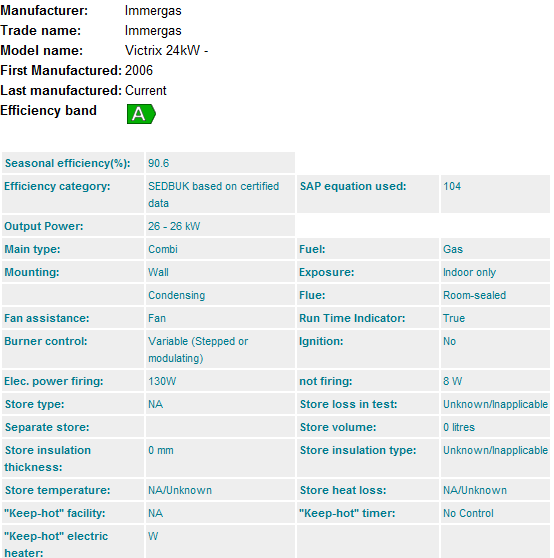
Water storage losses are set to zero for instantaneous combi boilers. As they normally serve several outlets, they will have distribution losses. Where the combi boiler can supply domestic hot water separate to space heating, Supplementary electric water heating is set to ‘No’.
There is no keep hot facility, as detailed in the HARP lookup above. Some instantaneous combi boilers will have a keep hot facility.
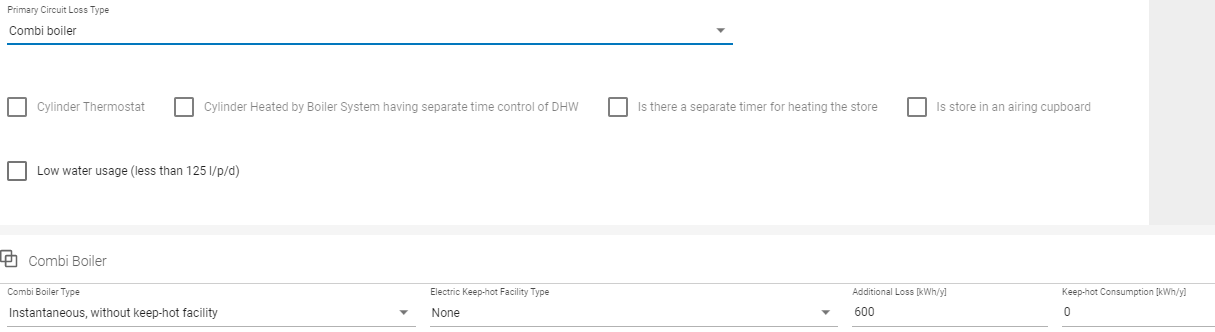
- ‘Combi boiler type ‘= ‘instantaneous without keep hot facility’
- ‘Electric keep hot facility type’ = ‘None’.
- ‘Primary circuit loss type’ = ‘Combi boiler’
See DEAP entry below.
Example 2 – Storage combi boiler store volume <55litres.
The screen shot below shows the HARP listing combi boiler with store volume < 55 litres and > 15 litres. This volume implies that this is not an instantaneous combi boiler or CPSU – it is a storage combi boiler.
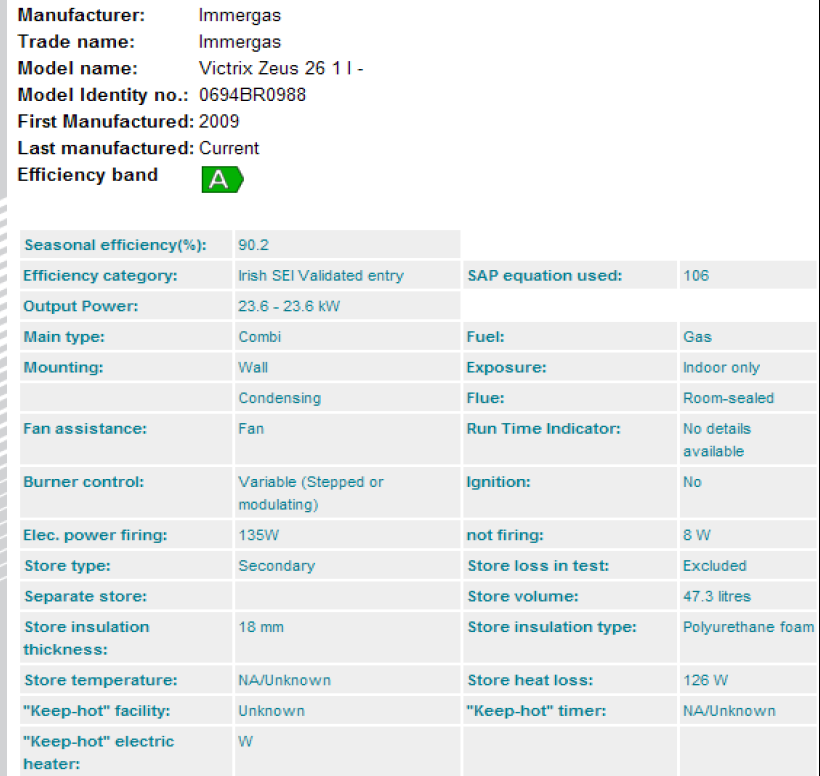
Water storage losses are set to ‘Yes’ for storage combi boilers. As they normally serve several outlets, they will have distribution losses. Where the combi boiler can supply domestic hot water separate to space heating, Supplementary electric water heating is set to ‘No’. When the unit is located indoors, ‘Yes’ is selected for ‘Is hot water storage indoors or in group heating scheme?’
The store type is secondary, the store insulation is polyurethane foam and the store insulation thickness is 18mm from the above listing. Using the Table 5.1 lookup in DEAP for temperature factor, the following detail is applied to the DEAP entry:

The combi boiler type selected is Storage Combi boiler store volume <55litres. The store volume from HARP is 47.3 litres, rounded to 47 litres in DEAP.
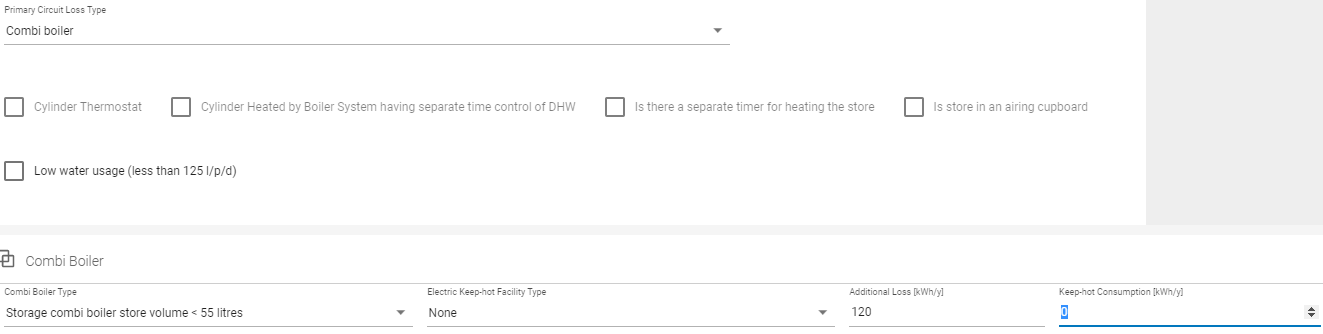
As the volume is less than 55 litres (but greater than 15 litres) the additional loss is calculated by the Assessor for entry in DEAP as follows using DEAP Table 5.4: Additional Loss = 600 – [ (V-15) * 15]. This gives an Additional Loss of 120KWh/yr for the combi boiler. The Assessor enters this in DEAP.
As there is no keep hot facility in storage combi boilers, ‘None’ is selected for electric keep hot facility type. The associated electricity consumption automatically derived by DEAP is zero as there is no keep-hot facility. ‘Combi boiler’ is selected for the primary circuit loss type. See DEAP entry below.
Note the Following:
- As per Hot water storage losses: For combi boilers, the storage loss factor is zero if the efficiency is taken from Table 4.5. The loss is included for a storage combination boiler if its heating efficiency is based on certified data or is obtained from HARP, using the calculated hot water storage loss factor and volume on the ‘Water Heating’ tab and the temperature factor from Table 5.1. The insulation thickness and volume should be provided by the manufacturer or obtained from HARP.
- Always assume the more pessimistic option if information is not available. For example, if unsure about ‘keep hot’ on an instantaneous combi boiler, select YES to keep hot. Where it is unclear if a storage combi boiler has a primary or secondary store, assume primary store present.
- Boiler interlock can be achieved for combi boilers by fitting a room thermostat
- If there is a keep hot facility present that operates by burning boiler fuel the “Electric keep hot facility type” entry is set to “None”.