¶ Group (community) heating/ district heating schemes
Group/community heating is defined as a system serving multiple dwellings from a central source within the boundaries of the site, where full details of the heat sources and spaces served is available.
District heating is defined as a central system serving multiple dwellings from a system outside the boundaries of the site.
Related Content
¶ Group heating where heat is produced by centralised unit by dedicated plant
In group schemes, also known as community schemes, heat produced centrally serves a number of dwellings or communal areas.
CHP (combined heat and power) is defined as the simultaneous generation of heat and electrical power in a single process. There are a number of ways of producing heat for group heating by a dedicated plant:
- heat produced by boilers only (Figure 11.1);
- heat produced by a combination of boilers and CHP units (Figure 11.2);
- other permutations of heating systems outlined in following sections.
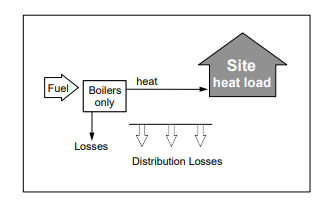
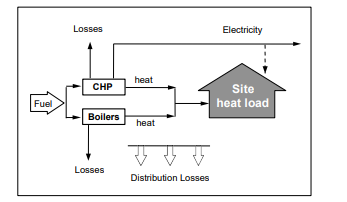
For group heating with CHP schemes, the CHP unit is the primary heat source, and back-up boilers of conventional design are used when the heat output of the CHP plant is insufficient to meet the instantaneous demand. The proportion of heat from CHP and from boilers varies between installations. The proportions of heat from the CHP and from conventional boilers, and the heat and electrical efficiencies of the CHP for the calculation of CO2 emissions, should be estimated, either on the basis of operational records or in the case of a new scheme on the basis of its design specification. Heat efficiency is defined as the annual useful heat supplied from a CHP scheme divided by the total annual fuel input (based on gross calorific value). The electrical power efficiency is the total annual power output divided by the total annual fuel input (based on gross calorific value).
The heat efficiency of the CHP should be based on the useful heat supplied by the CHP to the group heating, excluding any dumped heat (see Figure 11.3).
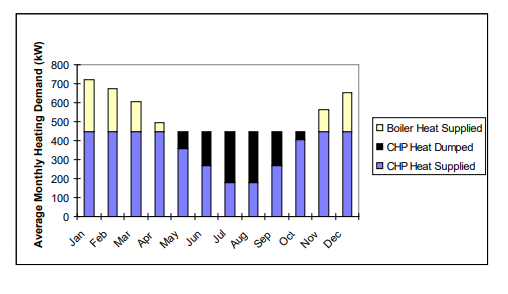
The energy required for space and water heating is calculated based on entries in the Space heating (Group) tab, designed for calculating energy usage when space and water heating is provided by group heating (with or without CHP). The CO2 emission and primary energy factors for group heating are taken from Table 12.1. These relate to delivered heat, so the emission factor is given in units of kilograms of CO2 emitted at the generating plant per kWh of heat delivered to the dwelling.
For group boilers, a default figure for the gross seasonal efficiency is given in Table 4.4 but, if known, the actual gross seasonal efficiency of the boilers should be used instead. For CHP plant, the efficiency is specified as the heat efficiency and the electrical efficiency; these may be determined from the overall efficiency and the heat-to-power ratio if these are the figures available. Default CHP efficiencies are provided in Appendix N where test data is not available.
DEAP assumes that dwellings with main space heating based on group heating schemes obtain their entire hot water requirement from the group heating scheme. The entry for ’supplementary water heating used in summer‘ in DEAP is deselected where the dwelling’s main heating system is a group heating scheme.
Note: In the case of group heating with CHP, both heat and electricity are produced, and the CO2 emissions associated with the fuel burnt have to be apportioned to the two forms of energy. In the DEAP calculation, the emissions saved by the CHP in displacing electricity from the national grid are subtracted from the total emissions associated with the group heating plant, and the remaining emissions are assigned fully to the heat produced.
¶ Heat distribution
Distribution losses
Heat losses in the distribution network within a building being heated by group or district heating must be accounted for in the BER calculation. These losses, in kWh/year are based on the flow temperature of the system. Table 11.1 lists the losses to be entered in the DEAP assessment for a range of flow temperatures.
Table 11.1 - Distribution heat losses for group heating
| System Flow Temperature | New default distribution heat losses (kWh/year) |
|---|---|
| ≤ 35 °C | 1250 |
| 36-45 °C | 1390 |
| 46-55 °C | 1530 |
| 56 -65 °C | 1640 |
| 66-75 °C | 1710 |
| 76-84 °C | 1790 |
| 85 °C and over | 1850 |
In order to select the losses for a particular system flow temperature, confirmation from the system designers/installers or from the facilities/building management of the building must be provided. Where this sign-off is not available for the flow temperature, 85 °C and over should be the assumed system flow temperature.
A non-default value can be used where a design specialist has carried out a heat loss calculation for the distribution network, and confirms that it has been carried out in accordance with EN 15316-3 or CIBSE Guide C.
Electrical energy for pumping
Energy associated with the electricity used for pumping water through the distribution system is allowed for by the DEAP software. DEAP adds electrical energy equal to 1% of the thermal energy required for space and water heating from the group heating system.
Hot Water Cylinders
Where hot water is provided from a group heating or district heating scheme:
a) If there is a hot water cylinder within the dwelling, its size and the appropriate loss factor should be used.
b) If the DHW is provided from the group or District heating scheme via a plate heat exchanger use the volume and insulation of the heat exchanger (rounded upwards to the nearest litre); if there are plate heat exchangers for both space and water heating use the volume of both added together.
c) Section H2 outlines treatment of group DHW solar heating schemes. Where solar water heating is provided from a larger shared solar water heating system, the total area of the solar panels is divided amongst the dwellings served by the solar water heating system proportionate to the total floor area of each dwelling.
d) If none of the above applies, the calculation should assume that the dwelling has a cylinder of 110 litres and loss factor of 1.672 kWh/day. Primary circuit loss for insulated pipework and cylinder thermostat should be included.
¶ District heating
District heating is defined as a central system serving multiple dwellings from a system outside the boundaries of the site.
District heating schemes include a range of systems:
- Utilisation of waste heat from process and power stations
- Utilisation of renewable energy sources
- Utilisation of conventional heat sources
A calculation methodology to account for the performance of specific district heating systems is under development. Default factors are used for district heating until a methodology for calculation is implemented. Approved default factors are taken from Table 12.1 or from separate SEAI guidance.

Heat distribution
Depending on the location of heat meters, the distribution losses of the secondary network may not have been accounted for in the district heating factors. In this case, the distribution losses according to table 11.1 should be used.
This is further explained in the separate guidance available on the SEAI Website on specific default factors for selected schemes.

Permutations of heat generators in group schemes
Possible systems for group heating schemes include:
- A single boiler or set of boilers all using the same fuel. Multiple boilers are specified using ‘Heating system 1/2/3‘ in the DEAP software.
- Up to three heat generators or three sets of heat generators, using different fuels such as mains gas and biomass. Multiple boilers are specified using ’Heating system 1/2/3‘in the DEAP software.
- Where a heat pump is present, the group heating heat pump calculator 2020 should be completed following guidance from the DEAP Heat Pump Methodology 2020. Efficiencies, fuel type and heat % should be entered in DEAP according to this guidance.
- CHP plant and boiler(s), calculations according as set out.
- Utilisation of district heating, calculations as set out in district heating above.
- Geothermal heat topped up by boilers. The calculation is the same as that described in district heating above for waste heat from power stations. This type of heat is from deep within the Earth and is not to be confused with ground source heat as used by standard heat pumps.
In the group heating section, the ‘percentage of heat’ entry for heating systems 1/2/3 is the percentage of heat the dwelling receives from the group heating scheme heat generators and is not reduced when CHP or secondary individual heating are present. This percentage of heat column only represents group heating appliances providing heat only and not electricity. Therefore, it does not include the portion of heat from CHP plant (which also generates electricity) or secondary heating (which is not part of the group heating scheme).
Group solar space and water heating
DEAP allows for solar heating to contribute to the main space and main water heating of the dwelling. If this type of system is present, the proportion of group heating provided by the solar space and water heating system should be specified. This proportion is calculated using the method detailed here.
Secondary heating
A dwelling where heating is available from a group heating scheme can also have its own secondary space heating system. The percentage of heat from secondary heating and the secondary heating system efficiency are calculated using the methodology set out in space heating.
CHP and district heating
A dwelling where heating is available from a group heating scheme can take some main space heating and main water heating from a CHP plant or from district heating. The proportion of heat supplied in this case should be taken from plant design figures or from operational records.
Solar water heating
If a dwelling where water heating is available from a group heating scheme obtains some of its hot water from a solar heating system, this is entered in the ‘Water heating: solar’ tab as detailed in water heating. This also applies to solar water heating systems shared amongst a number of dwellings.

Group scheme providing DHW only
Some group schemes provide DHW only, with the space heating provided by heaters in each dwelling (set to ’individual heating’ in DEAP). In this case the specification and calculation of space heating is the same as for a dwelling not connected to a group scheme. This includes a main heating system and secondary heaters. A DHW-only group scheme can be:
- from group boilers;
- from a group heat pump;
- from a group CHP;
- solar water heating in a group scheme is detailed in the Solar hot water section.
Data required are:
- fuel used by group scheme;
- efficiency of group boilers, heat pump or CHP (entered as the individual system water heating efficiency);
- if CHP, the heat-to-power ratio;
- heat distribution characteristics for the distribution losses in Table 11.1.
- hot water storage following guidance from options & storage
The efficiency adjustment factor, Table 4.6 (3), is applicable for water heating when the group scheme provides DHW only.
¶ Existing dwelling defaults.
For group heating systems, If details cannot be ascertained, they are defaulted to:
- System based on mains gas-fired boiler,
- Efficiency 75%,
- System flow temperature is 85 °C and over
- Pre-insulated, flat-rate charging.
Where a CHP system is present and details cannot be ascertained they are defaulted to:
- Fraction of heat from CHP = 0.30,
- CHP overall efficiency 75%,
- Heat to power ratio = 2.0.
- CHP electrical efficiency = 25%
- CHP thermal efficiency = 50%
¶ Group scheme providing cooling via air conditioning or heat pumps
Group schemes with cooling from air conditioning or heat pumps are treated the same way as individual cooling systems by identification of the SEER from test data, as outlined in Cooling.
Table 11.2 - Evidence requirements for group heating
| Space and water heat sources | ||
|---|---|---|
| Main Space and Water heating system |
DEAP Manual rules apply when determining heating system efficiencies. Details must be recorded on the DEAP Survey Form. Photographs of the heating system (e.g., boiler, heat pump, etc.) must be taken to support data inputs. Photographs of nameplates with make and model number can also be taken to support non-default efficiencies. Heating system manuals or installation certificates can also be copied and used as supporting data. In the absence of supporting data, default efficiencies in Table 4.4/4.5 must be used. |
|
| Secondary heating system |
DEAP Manual rules apply when determining secondary heating system efficiencies. Details must be recorded on the DEAP Survey Form. Photographs of the secondary heating system (e.g., room heater, etc.) must be taken to support data inputs. Photographs of nameplates with make and model number can also be taken to support non-default efficiencies. Heating system manuals or installation certificates can also be copied and used as supporting data. In the absence of supporting data, default efficiencies set out in space heating will apply. |
|
| Fuel data |
Details must be recorded on the DEAP Survey Form. If a solid fuel burner can burn more than one type of fuel, follow guidance in space heating section to determine the correct fuel type. |
Any documentation used to support choice of fuel(s) such as heating system product operation/warranty |
| Group heating scheme |
A bill showing evidence of charging based on heat consumed Documentary evidence confirming the % load from the group heating provider or system designer, etc., is also acceptable. Details must be recorded on the DEAP Survey Form. |
|
| District heating scheme |
A calculation methodology to account for the performance of specific district heating systems is under development. Until the calculation methodology is in place, only default primary energy and CO2 factors may be used. A recent bill or documentary evidence from the district heating provider for the property address is required to confirm the connection to a district heating. Details must be recorded on the DEAP Survey Form. See separate guidance for approved Fuel factor defaults other than those listed in Table 12.1 of the DEAP Manual. |
|
|
Distribution loss factor For group heating Schemes For District heating schemes |
The age of the dwelling may be required here. Supporting data / documentation from the service provider is also required for group heating schemes. See Table 11.1. Details must be recorded on the DEAP Survey Form. See Table 11.1. Details must be recorded on the DEAP Survey Form. |
Data/documentation from service provider confirming the design flow temperature of the system. |
| Combined Heat and Power (CHP) for group or individual heating system. | Details must be recorded on the DEAP Survey Form. Where available, efficiency data is taken from test reports based on a national standard or the CHP Directive 2004/8/EC. Photographs of the CHP system must be taken to support data inputs. |
|