¶ Heat pumps
Further Guidance
- Default data for Heat Pumps
- Non-default data for Heat Pumps
- Other heat pump types
- Heat Pump Examples
- Non-default Flow Temperature
¶ Introduction1
This section, and the sections listed above, detail the guidance for entry of heat pumps in DEAP. The heat pump methodology follows several key principles:
- Use of test results from standards aligned to the Energy Labelling2 and Ecodesign3 Directives as applied to heat pumps. Regulations implementing these directives establish product-specific requirements for products placed on the market from 26 September 2015. These are regulatory requirements for minimum performance and product information.
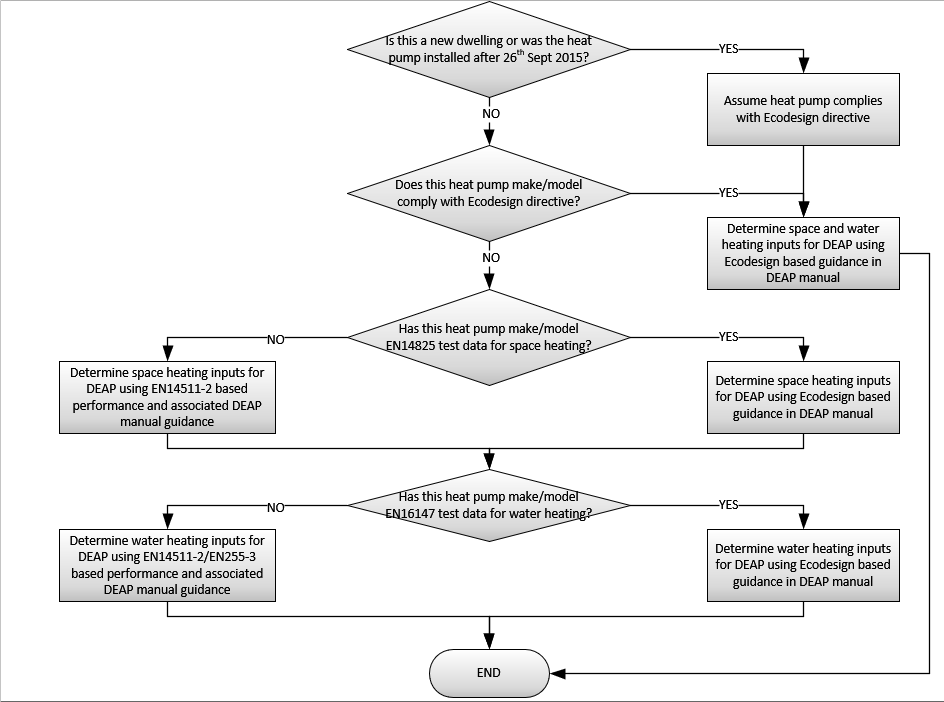
- Where a heat pump is installed in a dwelling from 26 September 2015, BER assessors must work on the basis that the heat pump make/model complies with the Energy Labelling and Ecodesign Regulations unless the manufacturer or supplier provides documentary evidence to support the reasoning for the product’s non-compliance. This applies to:
- All new-final and new-provisional domestic BER assessments;
- All existing dwelling assessments with the heat pump installed after 26th September 2015
- If the heat pump in these cases does not comply with the Ecodesign Regulations, and where insufficient supporting evidence has been provided to justify the lack of compliance with Ecodesign Regulations, default efficiencies must be taken from Table 4.4.
- For heat pumps installed prior to 26 September 2015, that heat pump make/model may or may not comply with Ecodesign Regulations.
- Where a heat pump make/model was installed before 26 September 2015 and does not comply with Ecodesign Regulations, the heat pump can still be entered in DEAP using the methodology previously applied to heat pumps prior to 2016 as outlined here. However, where the make/model is in scope of the Ecodesign Regulations for heat pumps, the new approach detailed here must be applied in DEAP assessments.
- For space heating, the methodology based on the data available from the Ecodesign Product Information requirements is incorporated using IS EN 14825 test data for heat pumps; the calculation methodology for system efficiency is based on IS EN 15316-4-2.
- For water heating, the new methodology based on the data available from the directives is incorporated using IS EN 16147 test data and the calculation methodology for system efficiency is based on EN15316-4-2.
- The methodology in this appendix and the DEAP software are supplemented by the following documents published here:
- A sheet for collecting relevant design details from the dwelling’s heating system designer or installer (Designer/Installer sign-off form);
- A document detailing a number of example cases for the heat pump methodology4.
- The heat pump calculation uses climate data for Dublin from Version 2.0 of ASHRAE’s International Weather Files for Energy Calculations (IWEC2).
- Ecodesign Regulations refer to different types of heat pumps, broadly categorised as providing space heating only, water heating only, or combination heaters (providing space and water heating). For warm air heat pumps, the relevant Ecodesign Regulations are those for air-conditioners and air products.
- As per the BER assessors Code of Practice, all data used in compiling the BER assessment must be retained on file by the BER assessor. For heat pumps, this includes but is not limited to:
- Heat pump test performance documentation used in the calculation according to relevant standards/regulations/directives.
- The designer/installer signoff sheet filled out for the dwelling being assessed as referenced in G1.2.
- Any calculations demonstrating a lower design flow temperature for space heating other than the default values calculated by DEAP. This applies where a non-default design flow temperature is specified in DEAP.
The following diagram outlines the approach to use based on availability of Ecodesign data or associated test data where the heat pump is the main space and/or water heater in the dwelling:
¶ General guidance for the heat pump methodology
Data for the heat pump system is entered in the DEAP software under the ‘Space heating: heat sources’ tab. DEAP uses the data entered for the heat pump along with heat demand calculations based on inputs to the Building and Ventilation tabs. DEAP then derives system efficiency figures for the space and water heating calculation in DEAP.
When entering the heat pump in the ‘Heat source’ sub-tab, there are several fields to be completed. A new heat pump is entered by selecting ‘add new item to library’ in DEAP:
- ‘Basic properties’ sub tab
- Select ‘Heat source’ as the item type, and ’Heat pumps‘ as ‘Heating source type’
- Enter manufacturer/model details for the heat pump.
- ‘Heat pump details’ sub tab
- Enter the type of heat pump (e.g., A/W; B/W etc.)
- Where a ’to air‘ system is selected, the heating design sheet (see box in this section) must be filled out by the designer/installer. If evidence is not available that the system meets the heating demand of the dwelling, the guidance in Appendix A must be followed.
- Enter the type of heat pump (e.g., A/W; B/W etc.)
- Specify the ‘Space heating standard’ if the heat pump is the main space heating system. The standard is IS EN 14825 where Ecodesign applies or data to this standard is available as per Figure G1 above.
- Specify the ‘Water heating standard’ if the heat pump is the main water heating system. The standard is IS EN 16147 where Ecodesign applies or data to this standard is available as per figure G1 above.
- The seasonal space heating energy efficiency is entered as a percentage. This is the seasonal space heating energy efficiency (ηs) taken directly from Ecodesign data
- The water heating efficiency (ηwh) is entered as a percentage and is taken directly from Ecodesign data (see G3 below)
- If Ecodesign does not apply, and test data to the standards above is not available, the test standard IS EN 14511 applies (or EN255-2 / EN255-3 as outlined in this appendix). In this instance, the seasonal space heating efficiency and the water heating efficiency are taken from HARP (or from DEAP Table 4a defaults if HARP data is not available).
- Identify the type of temperature control (capacity control) as identified in Ecodesign test data where applicable. This will be ’Fixed‘ or ’Variable‘ outlet.
- Enter the operation limit temperature (TOL – OC) and heating water operating limit temperature (WTOL - OC) taken from Ecodesign technical data where applicable.
- If IS EN14511-2 applies for water heating, then see Section G2 and the “Note on DHW flow temperature” in the text box below when specifying the presence of an immersion and the flow temperature of the heat pump.
- If the heat pump provides cooling, the SEER should be entered here.
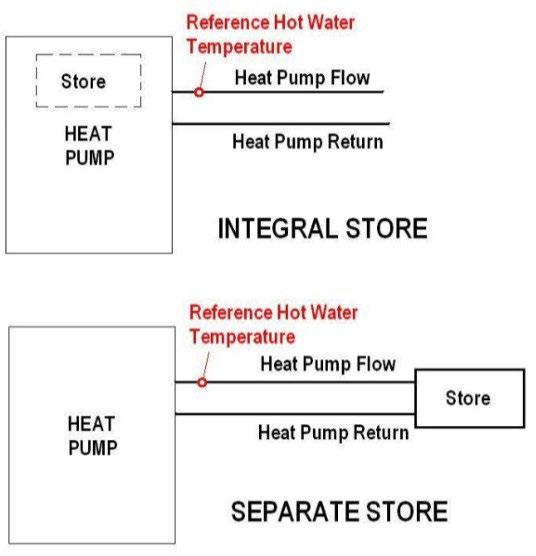
Note on DHW flow temperature – for IS EN 14511- 2 data only:
According to requirements of standards and guidelines addressing Legionnaires Disease, DHW is required to be stored and supplied at a temperature of 60⁰C or more.
Where IS EN 14511- 2 test data is used for water heating, it is necessary for the user to select whether the heat pump reaches the required flow temperature or not.
The following rules apply when determining if this requirement is met for DEAP:
- Where the DHW store is separate from the heat pump, in order to achieve a 60⁰C storage temperature the flow temperature from the heat pump must be at least 65⁰C. Otherwise, the heat pump is not assumed to be capable of heating the DHW store and supply to 60⁰C. This is based on an assumed temperature drop of 5⁰C from the heat pump to the DHW store as established in the SAP methodology.
- Where there is no DHW store outside the heat pump (for example there is an internal store only or no hot water storage), the heat pump must be able to reach a flow temperature of at least 60⁰C. Otherwise, the heat pump is not assumed to be capable of heating the DHW store/supply to 60⁰C.
- If it is not clear if the heat pump can heat the DHW store/supply to 60⁰C, it is assumed that it cannot.
- ‘Heat pump test data’ sub tab
- Heating system test data: IS EN 14825 and IS EN 161475 for space and water heating:
- Using the standards identified under the ’Heat pump data‘ section above, DEAP displays the required heat pump performance entries for space and water heating.
- Section G3 below provides further detail on the data required.
- Heating system test data: IS EN 14825 and IS EN 161475 for space and water heating:
- ‘Edit primary heat source’ sub-tab: once the heat pump has been successfully entered, the heat pump calculation requires additional information on the heat pump system specific to the dwelling being assessed:
- Enter design flow temperature (⁰C). This is either defaulted by DEAP or overridden by the user based on dwelling design data. Where non-default flow temperatures are used, the SEAI heating design sheet (or equivalent) must be filled out by the designer/installer.
- Select the number of running hours per day that the heat pump is in operation based on dwelling design data: eight, sixteen or twenty-four hours. If not provided by the designer/installer, assume the default of eight hours, as based on the DEAP heating schedule. The number of hours chosen should be based on the closest value to the design proposal. This is the number of hours during which the heat pump can be activated by thermostatic/load control devices to maintain the occupant’s required thermal conditions in the dwelling according to the system designer/installer.
- Heat pump Type of DHW’:
- Select whether the heat pump has a separate hot water store, an integral hot water store or no hot water store. An integral store is defined as a store within the heat pump casing and is part of the heat pump. The reference hot water temperature from the heat pump test data is after/ downstream of the store
- DEAP determines the required hot water flow temperature from the heat pump based on the presence of an integrated or separate hot water store, following the principle outlined in the text box above.
- Enter details of backup main space and water heating systems (if present), including fuel type, and efficiency. Backup efficiency data can be sourced from HARP, certified data or DEAP defaults. The main space heating backup heater is not the secondary heating system. It is any other system capable of heating multiple rooms in the dwelling and supplementing the heat pump, such as a backup boiler. If a system is considered as a heat pump backup, it is not eligible to be considered as a secondary heating system in DEAP. The combination of a space heating heat pump and backup space heater are considered as the main space heater in DEAP. The combination of a water heating heat pump and backup water heater are considered as the main water heater in DEAP. If the backup heater is a room heater with boiler, the methodology outlined in Section 9.2.4 of the DEAP manual is followed.
Note on the Heating design sheet
The heating design sheet is a tab on the Designer/Installer Sign-off Excel file, available from the SEAI Website. It must be filled out by the person signing off on the heat pump design and installation and must reflect what is installed in the dwelling.
The BER assessor must upload the complete Designer/Installer Sign-Off to DEAP as documentary evidence for the BER.
The heating design sheet contains the following information for each room in the dwelling:
- Summary of room-by-room heat loss calculations in accordance with the following:
- SR 50-1 Building services - Code of Practice - Part 1: Water based heating systems in dwellings.
- SR 50-4 Building services - Part 4: Heat pump systems in dwellings
- For each room, the summary includes:
- Type of emitter along with radiator/ fan coil unit manufacturer & model/size where applicable
- Single heat emitter output, no. of emitters, total heat emitter output.
- The ΔT for heat output for radiator and fan coil systems, where applicable
- The output for underfloor heating in W/m2, where applicable
- Design room temperature
- For a ’to air‘ system, supply air temperature, where greater than 27⁰C, must be supported by manufacturers’ data
- For a ’to air‘ system, air flow rate for each room, where applicable.
- Heat capacity of the heat pump at design conditions6 from Ecodesign data or accredited test data
- Floor area of the dwelling
¶ Input from the designer/installer
The following data is required from the system designer or installer for heat pumps to enable assessment of the heat pump in DEAP. The BER assessor will require that for any heat pump to which Ecodesign, EN14825 or EN16147 is applied (see figure G1), a sign off sheet is completed and signed by the designer/installer of the heat pump system. The sheet may be provided by the designer/installer in hardcopy or softcopy format signed using one of the following methods:
- Hardcopy signed by the designer/installer, or
- Softcopy format with an electronic (e.g., scanned) signature from the designer/installer, or
- Softcopy format accompanied by an email from the designer/installer confirming that the data with the sign-off sheet is correct.
SEAI has provided a template for this sheet to accompany the DEAP heat pump assessment:
Table 4.22 – Designer/installer sign-off sheet required data
| Designer/installer sign-off sheet | |
|---|---|
| General Information | Notes |
| Includes dwelling details | |
| Purpose of installation | |
| Identifies if the heat pump is supplying space / heating / domestic hot water / both | Confirm during site survey |
| Heat pump selection | |
| Make, model and any model qualifier for the heat pump identified in the dwelling being assessed | Confirm during site survey & for “to air”, the completed heating design sheet (or equivalent) must be obtained from the designer/installer |
| Type of heat pump (e.g., A/W; B/W etc.) | |
| Date of installation | Any heat pump installed after 26 September 2015 must be Ecodesign and Energy Label Directive compliant |
| Confirmation of compliance with the Ecodesign and Labelling Directive | |
| Confirmation of test standards for the heat pump | |
| Confirmation of hours of operation per day, (eight, sixteen, twenty-four) closest to the number of hours of operation expected by the design. This is the number of hours during which the heat pump can be activated by thermostatic/load control devices to maintain the occupant’s required thermal conditions in the dwelling. | |
| Confirmation of any backup systems installed to supplement the heat pump including backup heater details and fuel type. | The main space heating backup heater is not the secondary heating. It is any other system capable of heating multiple rooms in the dwelling and supplementing the heat pump, such as a backup boiler. If a system is considered as a heat pump backup, then it is not eligible to be considered as a secondary heating system in DEAP |
| Heating design (see text box in G1.1) | |
| Heat emitters present in the dwelling | Confirm during site survey |
| Heating controls within dwelling | Confirm during site survey |
| Design flow temperature based on design conditions | Where this is a non-default flow temperature, the completed heating design sheet (or equivalent) must be obtained from the designer/installer. |
| Domestic hot water | |
| Confirmation of hot water temperature based on certified data. | Check against certified data |
| Confirmation of the type of store present | Confirm during site survey |
| Confirmation that all hidden primary pipework is insulated or not. | Any insulation on the visible primary pipework must be confirmed during survey. |
| Confirmation of the presence of immersion/ electric element in the heat pump capable of providing domestic hot water. | This must be specified even if this integral immersion is only installed as a backup to the heat pump. |
| Confirmation | |
| Sign-off and details of system designer/installer is required | |
1 - The guidance in this appendix has been updated to incorporate the DEAP heat pump methodology in use since 2016 and amended to facilitate integration of the full heat pump calculation into the DEAP software (prior to this, the calculation tool was in a standalone Microsoft Excel workbook). The heat pump tool as integrated into the DEAP software supersedes the Microsoft Excel version of the calculation for the purposes of BER assessments and Part L compliance checking.
2 - Regulation (EU) 2017/1369 setting a framework for energy labelling and repealing Directive 2010/30/EU on the indication by labelling and standard product information of the consumption of energy and other resources by energy-related products
3 - Directive 2009/125/EC establishing a framework for the setting of Ecodesign requirements for energy- related products.
4 - The examples document currently reflects the Microsoft Excel version of the heat pump calculator and is due to be updated to reflect the heat pump inputs in the DEAP software. The inputs in the software are similar to those in the Excel tool, although many are no longer visible as DEAP automatically passes several fields to and from the heat pump calculation to the remainder of the DEAP assessment, thereby simplifying the process for the user.
5 - Test data similar to IS EN 16147 is required if specifying data to IS EN 255-3
6 - The design conditions for Ireland specify an outdoor design temperature of -3⁰C. The full load capacity at the closest conditions, on the conservative side, should be used.